

The Identity Crisis You’re Avoiding
You likely believe that integrity is a fixed personality trait—a moral badge you earned years ago and wear to feel superior. You are wrong. Integrity is not a static state of being; it is a clinical, daily behavior pattern.
The core problem you are avoiding is simple: You choose self-protection over the truth to keep your preferred identity from collapsing. You are more invested in looking like a good person than in the grueling work of actually being congruent. If the idea that your “good person” label is a lie makes you uncomfortable, good. Discomfort is where honesty starts. This is an advanced audit of your self-deception.
Integrity is a Daily Behavior, Not a Personality Trait
Integrity is not about being “better” than others; it is about the surgical alignment of your values, words, and actions in real-time. This alignment is irrelevant when it is convenient. Advanced integrity is only measured when it costs you something—specifically when it costs you validation, access, comfort, or control.
At this level, you must prioritize impact over intent. Explaining your “good intentions” is almost always a form of self-protection used to avoid the consequences of your behavior.
- Owning impact without explaining intent: You stop telling people what you “meant” to do and start owning what you actually did.
- Allowing consequences: You stop demanding that others understand your heart and start letting the weight of your actions land.
- Choosing clarity over being liked: You speak the truth even when it terminates the approval you crave.
You Aren’t Self-Aware, You’re Strategic
“Integrity is not about being the better person. It’s about being the braver one.”
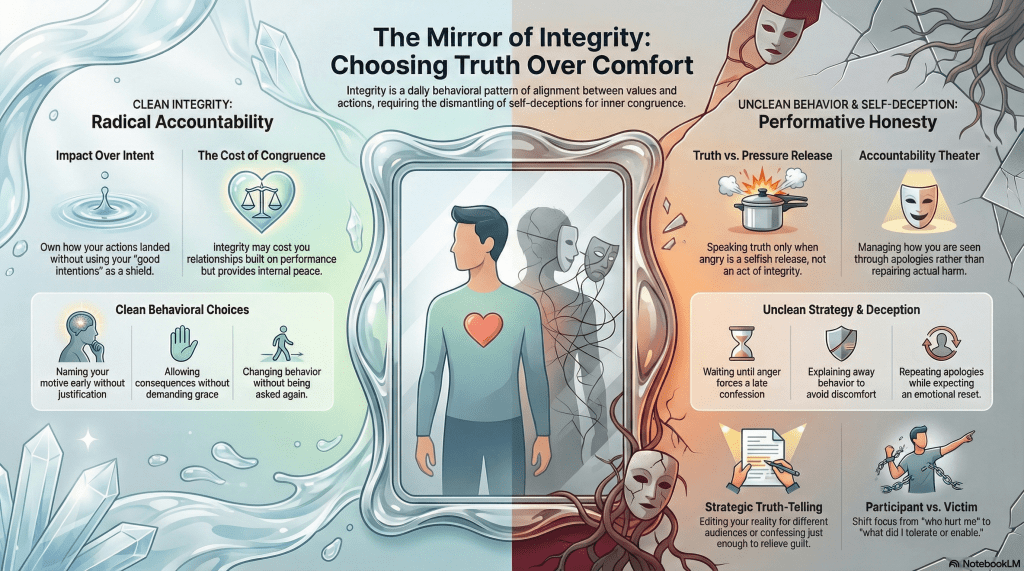
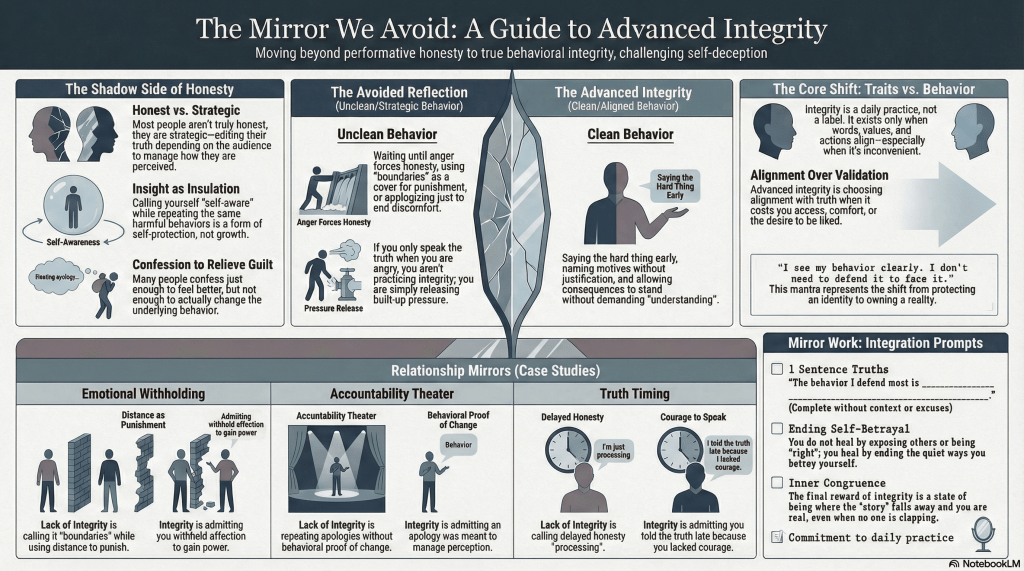
Most people who claim to be “self-aware” are actually just strategic. You use “insight as insulation,” becoming an expert at describing your flaws so that you never have to correct them. This is a tactical move to maintain leverage in your relationships while avoiding real friction.
Cognitive Strategies of Self-Deception:
- Weaponized Vulnerability: Sharing just enough “messiness” to garner sympathy and deflect from actual accountability.
- Editing the Truth: Shifting the narrative depending on the audience to ensure your identity remains protected.
- Selective Honesty: Confessing minor infractions to relieve guilt while hiding the core deceptions that would cause an identity collapse.
- Insight as Insulation: Using your understanding of “why” you behave a certain way as a shield against the requirement to change.
If you are repeating the same behavior while calling yourself self-aware, you are not growing; you are just becoming a more sophisticated liar.
Delayed Honesty is Pressure Release, Not Integrity
You likely congratulate yourself for finally “speaking your truth” after weeks of silence, calling it “processing.” In reality, calling delayed honesty “processing” is a lie used to mask avoidance.
If you wait until you are angry, resentful, or backed into a corner to be honest, you are not practicing courage. You are practicing pressure release. You are using your emotions as a shield to discharge internal tension rather than seeking alignment. Integrity is saying the hard thing early, before the pressure forces it out of you.
“Clean means: No manipulation, no omission, no emotional leverage, no delayed honesty.”
You Can Be Harmed and Still Lack Integrity
A common trap of the “good person” identity is using victimhood to erase your own lack of integrity. You can be genuinely harmed by someone else and still handle that harm with “unclean” behavior. Advanced integrity does not ask, “Was I justified in my reaction?” It asks, “Was I clean in how I handled this?”
You must perform a brutal audit of the role you played in your own suffering. Victimhood becomes a distortion when it is used to hide your participation.
The Role You Played: A Self-Audit
- Where did I know the truth, but choose not to know it? (Ignoring red flags to maintain a connection).
- Where did I sense misalignment and choose to override it? (Trading self-respect for the sake of not being alone).
- Where did I tolerate, avoid, enable, or repeat the very patterns I complain about?
Stop Performing “Accountability Theater”
“Accountability Theater” is the act of apologizing to manage someone’s perception of you or to end the discomfort of a conflict. If your apology is designed to “reset” the relationship without a corresponding change in behavior, it is a performance of repair, not the reality of it.
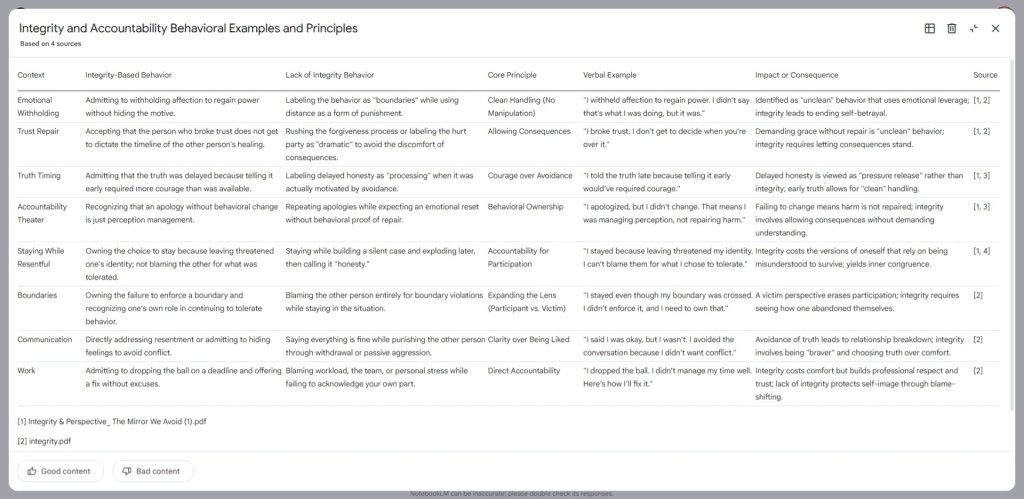
| Integrity (Clean Behavior) | Lack of Integrity (Unclean Behavior) |
| Owning Impact: Acknowledging the harm done without shifting focus to your “intent.” | Accountability Theater: Repeating apologies to end discomfort while demanding grace without repair. |
| Direct Ownership: “I withheld affection to regain power. I used distance to punish you.” | Weaponized Jargon: Calling withdrawal a “boundary” to avoid being seen as manipulative. |
| Staying Clean: “I stayed because leaving threatened my identity. I can’t blame you for what I chose to tolerate.” | Case-Building: Staying while resentful, building a silent case, then exploding and calling it “honesty.” |
| Truth Timing: Saying the hard thing early, even when it requires immediate courage. | Avoidance: Calling delayed honesty “processing” when you were actually just hiding. |
| Letting Consequences Stand: Allowing others to be upset without trying to “correct” or manage their feelings. | Leverage: Provoking a reaction, then pointing to that reaction as proof that you are the one being harmed. |
The High Cost (and Higher Reward) of Congruence
Living with integrity is expensive. If you choose to be congruent, you will lose relationships that were built on your performance. You will lose roles where you were needed but not respected. You will lose the versions of yourself that relied on being “misunderstood” to survive.
The reward is Inner Congruence—a state where your internal world and external reality finally match. You no longer have to manage different versions of the truth to protect a fragile ego.
Integration Exercise: Stop and ask yourself: “What part of my identity depends on not seeing this clearly?”
Ending the Self-Betrayal
Healing does not come from exposing the flaws of others or being “right” about how you were treated. You heal by ending the quiet, subtle ways you betray yourself to keep the peace or protect an image. Integrity is what remains when the stories you tell yourself finally fall apart.
“Integrity is not who you think you are. It’s who you are when the story falls apart.”
Final Thought: What would integrity cost you right now?
Discover more from Healing from Narcissistic Abuse, Toxic Relationships & Codependency | Christina Stuller
Subscribe to get the latest posts sent to your email.
