There’s a specific kind of erasure I need to tell you about.
You don’t see it coming. One day you’re accepting a favor. The next, you’re drowning in debt you never agreed to.
It happens when someone you love turns every good thing they ever did into a weapon.
Kindness gets weaponized. The birthday they remembered five years ago becomes evidence in today’s argument. The time they drove you to the airport gets added to an invisible ledger you didn’t know you were signing.
Love becomes transactional.
And here’s the part nobody warns you about.
The hurt doesn’t stop there. It rewrites your entire history.
The Moment You Realize You’ve Been Keeping Someone Else’s Books
You start remembering the good times differently.
The vacation you took together? The one where you laughed until your stomach hurt?
It’s tainted now.
Three months ago, during a fight about dishes in the sink, they brought it up. “After I paid for the entire trip to the coast, you still won’t do one thing for me?”
The gift they gave you last Christmas sits on your shelf. You don’t look at it the same way anymore.
It’s no longer a gift.
It’s evidence. Exhibit A in the case they’re building against your character.
Every act of love you thought was freely given? Turns out strings were attached. You didn’t see them until they started pulling tight.
Research shows people in the rescuer role hide wrongdoing behind favors. These favors become strings binding you. They never need accountability because they’ve done enough already.
As long as they occupy the role, you’ll always be “the ungrateful one.”
This is the architecture of emotional debt.
And you didn’t agree to any of it.
The Weaponization of Generosity
Here’s what makes this so devastating.
The acts themselves were often real.
They did drive you to the airport at 5 AM. They did remember your birthday when you turned 30. They did help you move boxes up three flights of stairs. They did listen when you were struggling with your job.
Somewhere along the way, those moments stopped being about connection.
They started being about control.
Covert narcissists turn generosity into control through what experts call “favor fishing.” Every favor they do is a transaction. You’re expected to pay back on their terms.
They bring up favors repeatedly. Reminding you of how much they “sacrificed.” Creating guilt and obligation.
You start to notice a pattern:
Every time you set a boundary, they bring up the past.
Every time you express a need, they remind you of theirs. Every time you try to stand up for yourself, they pull out the ledger and start reading.
“Remember when I stayed up all night with you after your mom’s surgery?”
“Remember when I canceled the golf trip to help you paint the living room?”
“Remember when I turned down the job in Seattle for you?”
And suddenly, you’re not having a conversation about the present.
You’re being cross-examined about your failure to properly appreciate the past.
The Erosion of Joy
Here’s where the real damage happens.
You stop being able to receive anything without calculating its future cost.
A compliment becomes a down payment on compliance. A kind gesture becomes a trap. Their affection becomes surveillance.
You don’t enjoy the present anymore. You’re too busy preparing for how they’ll use it against you in the future.
The memories you used to smile about now make you sick.
You know they’re not yours anymore. They belong to the narrative someone else is building. The one where you’re perpetually in debt, perpetually ungrateful, perpetually wrong.
They’ve taken your history and turned it into evidence of your inadequacy.
Research confirms keeping score in relationships doesn’t just reflect existing problems. It predicts future decline.
People who showed slower declines in exchange orientation experienced steeper drops in relationship satisfaction over the years. Keeping score foreshadows relationship struggles.
You feel it happening inside you.
The slow collapse of trust. The gradual withdrawal of vulnerability. The protective shell you’re building around every interaction.
Intimacy requires goodwill.
And goodwill dies under constant evaluation.
Why Leaving Feels Impossible
People who haven’t lived here ask the obvious question.
“Why don’t you just leave?”
They don’t understand the psychological architecture keeping you locked in place.
Trauma bonding creates a cycle where mistreatment alternates with sporadic acts of kindness, affection, or remorse.
This intermittent reinforcement makes the original “good deeds” feel more significant than they were. You stay trapped.
You’ve been conditioned to believe you owe something.
The debt feels real. It sits in your chest like a stone.
Leaving means admitting all those good memories were contaminated from the start.
It feels like losing your entire history.
They’ve convinced you your feelings are evidence of your failure. Your hurt is proof of your ingratitude. Your exhaustion? A character flaw.
You stay because the cost of leaving feels higher than the cost of staying.
Until one day.
The equation shifts.
The Math Finally Adds Up
There comes a moment when you realize something fundamental.
You stop measuring what you’ll lose by leaving.
You start measuring what you’re losing by staying.
Your peace. Your clarity. Your ability to trust your own perception. Your capacity for joy. Your sense of self.
You realize the “damage of walking away” they keep warning you about is nothing compared to staying in a relationship where love has become a ledger and connection has become a courtroom.
The long-term mental health consequences of toxic relationships are well-documented. Prolonged stress from toxic interactions contributes to depression and post-traumatic stress disorder. People report persistent insecurity, low self-worth, and emotional numbness years after leaving.
Here’s what they don’t tell you about staying.
It compounds.
Every day you remain in a relationship built on emotional debt, you lose a little more of yourself.
Every conversation turns into an interrogation about your gratitude. Your ability to trust your own reality erodes. Every good memory gets weaponized.
It takes something irreplaceable from you.
What You’re Losing
You’re losing your right to have needs without justification.
You’re losing your ability to set boundaries without negotiation.
You’re losing the capacity to receive love without fear.
You’re losing the freedom to remember your own life the way you experienced it.
Not the way someone else needs you to remember it.
You’re losing the present trying to pay for a past you never agreed to purchase.
And the cruelest part?
The person keeping the ledger will never mark your debt as paid. No amount of compliance, gratitude, or self-erasure will satisfy the accounting.
The ledger isn’t about what you owe. It’s about maintaining the power to say you owe.
The Permission You Don’t Need
I’m not going to tell you to leave.
I’m not going to say you deserve better.
Though you do.
I’m not going to promise walking away will be easy.
It won’t be.
What I will tell you is this: you don’t need permission to stop accepting this as love.
You don’t need to justify your exhaustion. You don’t need to prove your case. You don’t need to wait until the ledger is balanced.
It never will be.
The damage of staying is measured in moments you won’t get back. Joy you couldn’t feel. Memories you won’t access without contamination.
In years spent trying to earn something meant to be freely given.
The damage of leaving is sharp and immediate.
It’s the pain of extraction. Of separation. Of rebuilding.
It’s finite, though.
And on the other side of the pain is something you’ve forgotten exists.
Love without ledgers. Connection without calculation. Generosity without strings. Memory without weaponization.
The possibility of a relationship where the past stays in the past and the present belongs to you.
What Comes After
You’ll know you’re healing when you receive a kindness without bracing for impact.
When someone does something thoughtful and you don’t immediately start calculating what you’ll owe them later.
When you look back at good memories and feel the joy again.
Not the dread.
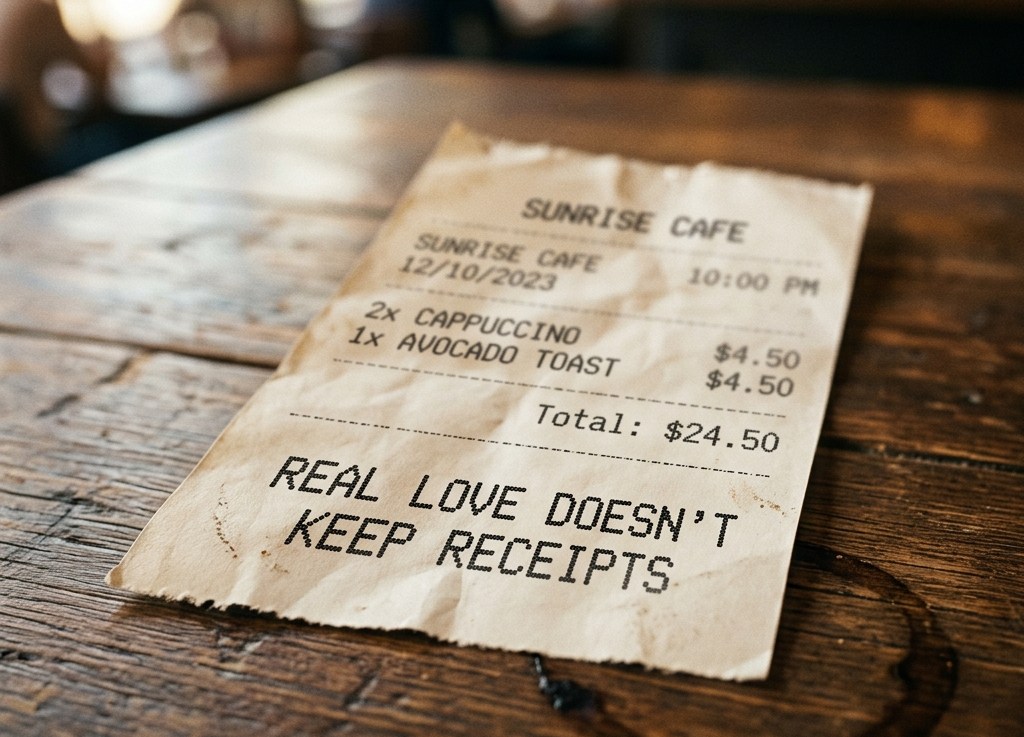
When you realize real love doesn’t keep receipts.
It doesn’t build cases. It doesn’t turn your history into evidence of your inadequacy.
Real love creates space. It builds trust.
It allows for mistakes without permanent record-keeping. It gives freely and receives gratefully without turning either into ammunition.
You deserve to remember your life the way you lived it. You deserve to feel your feelings without them being used as proof of your ingratitude.
You deserve relationships where generosity is genuine and connection doesn’t come with terms and conditions.
You deserve to stop paying for love meant to have been free all along.
The ledger was never real.
The debt was manufactured. The obligation was imposed.
The moment you realize it is the moment you start writing a different story.
One where your past belongs to you. Where your present is yours to inhabit. Where your future isn’t mortgaged to someone else’s narrative about your inadequacy.
That’s not damage.
That’s liberation.
And it’s waiting for you on the other side of a decision only you make.
If you’re ready to stop living by someone else’s ledger and start reclaiming your own story, I’m here.
Schedule a session with me at healingmyfeelings.com. Let’s rebuild the trust you’ve lost in yourself and create space for relationships where love doesn’t come with strings.
Discover more from Healing from Narcissistic Abuse, Toxic Relationships & Codependency | Christina Stuller
Subscribe to get the latest posts sent to your email.
