Stop Telling Trauma Survivors to “Let It Go”

Test Gadget Preview Image

I need to say something that’s going to make some people uncomfortable.

The healing culture we’ve built is gaslighting survivors.

You’ve heard it before. Someone shares their experience with narcissistic abuse, the aftermath of complex trauma, the weight they still carry from years of emotional manipulation. And within minutes, someone responds with the same tired advice: “You just need to let it go.”

As if healing were a light switch. As if trauma were a choice you’re making every morning when you wake up.

This isn’t support. This is spiritual bypassing dressed up as wisdom.

I’ve watched this pattern destroy people who were already fighting to survive. The pressure to “move on” becomes another form of abuse, another voice telling survivors their reality doesn’t matter, their pain isn’t valid, their timeline is wrong.

Research confirms what survivors already know: toxic positivity functions as gaslighting. It exacerbates symptoms of PTSD, depression, and anxiety. It creates isolation and shame that makes it harder for survivors to seek help.

When you tell someone to “just let it go,” you’re not offering healing. You’re offering erasure.

The Problem With Quick-Fix Healing

Our culture is obsessed with resilience porn.

We want the tidy narrative arc. The transformation montage. The before-and-after that proves healing is possible if you just try hard enough, think positive enough, release enough.

But trauma doesn’t work that way.

Healing from narcissistic abuse takes months or years, depending on the depth of the relationship and the support system in place. Recovery isn’t linear. Setbacks don’t mean you’re failing. They’re part of the process.

The pressure to “bounce back” reflects our collective discomfort with intense emotions. We want quick fixes and easy answers because sitting with someone’s pain makes us uncomfortable.

So we rush to solutions. We offer platitudes. We suggest letting go before the person has even been allowed to hold on.

This isn’t compassion. This is avoidance.

People are largely so uncomfortable with holding space for survivors that they rush to the solution stage to make the discomfort go away. But that’s not what survivors need. One of the biggest contributors to moving unconsciously toward relationships that feel familiar but unsafe is not being truly seen and heard.

When “Letting Go” Mirrors the Original Trauma

Here’s what most people don’t understand about toxic positivity and trauma survivors.

For survivors of narcissistic abuse, being pressured to be positive can mirror aspects of their original trauma. Especially if their traumatic experiences involved having their emotions dismissed or being forced to suppress their true feelings.

You’re asking someone who spent years being told their reality didn’t matter to now dismiss their own experience.

You’re asking someone who learned to silence their needs for survival to silence themselves again. For your comfort this time.

This runs counter to every principle of trauma-informed care. Trauma-informed approaches emphasize validation, safety, and empowerment. They create space for the survivor’s experience without rushing to fix, solve, or transcend.

When you tell a survivor to let go, you’re repeating the same pattern that caused the wound in the first place.

The narcissist told them their feelings were wrong, too dramatic, too sensitive. The narcissist insisted they move on from the hurt they caused. The narcissist demanded forgiveness without accountability.

Sound familiar?

The Neuroscience of Why You Can’t Just Let Go

For those who experienced complex trauma—repeated childhood neglect, emotional abandonment, or abuse—the past isn’t just history.

It’s a survival manual your nervous system still follows religiously.

Your body learned to read danger in specific tones of voice, facial expressions, silences. These patterns got encoded as protection. Your nervous system built an entire threat-detection system based on what kept you safe when you were powerless.

Letting go isn’t about willpower. It’s about updating your survival manual with new, more accurate information.

This takes time. It requires safety. It demands validation of what was real.

When you experienced years of being told you’re wrong or incapable, your judgment gets compromised. Many survivors describe feeling as if they lost their sense of identity. Making decisions becomes difficult because you learned not to trust yourself.

You can’t think your way out of what your body learned for survival.

What Suppressing Emotions Actually Does

The “let it go” crowd believes they’re helping you avoid getting stuck in your pain.

What they’re actually doing is teaching you to bypass, blunt, stuff, deny, and numb.

Constantly suppressing emotions results in both mental and physical illness. When we deny ourselves access to authentic emotional experiences, the cracks eventually show. Our feelings manifest in distressing and confusing ways: anxiety, depression, dissociation.

The energy of suppressed emotions doesn’t disappear. It remains deep inside your consciousness, preventing actual healing.

You can’t heal what you’re not allowed to feel.

Research shows that when people invalidate our negative emotions, we start to believe our emotions are wrong. And because we can’t just change how we feel, toxic positivity becomes unsustainable. The pressure builds. The disconnection deepens.

Eventually, something breaks.

The Difference Between Validation and Wallowing

I know what some of you are thinking.

“But Christina, aren’t you just encouraging people to stay stuck in victim mentality?”

No. I’m encouraging people to stop pretending their trauma didn’t happen so other people feel more comfortable.

There’s a difference between validation and wallowing. There’s a difference between processing and performing. There’s a difference between healing and hiding.

Validation says: what happened to you was real. Your response makes sense. You’re not broken for still carrying this.

Wallowing says: this defines you forever. You have no agency. Your past determines your future.

I teach people to build boundaries, recognize patterns, and develop functional autonomy. But none of that happens by skipping over the part where we acknowledge what was true.

You don’t build a foundation by pretending the ground isn’t damaged.

Most people naturally recover from trauma symptoms over time. Their reactions lessen. But it can take days, weeks, or months. Ignoring or avoiding symptoms isn’t a healthy coping response. In fact, avoiding them makes things worse.

What Survivors Actually Need

Survivors don’t need you to fix them.

They need you to believe them. To sit with them. To stop rushing them through their own experience because it makes you uncomfortable.

They need space to name what happened without being told it wasn’t that bad, they’re being too sensitive, or they should have left sooner.

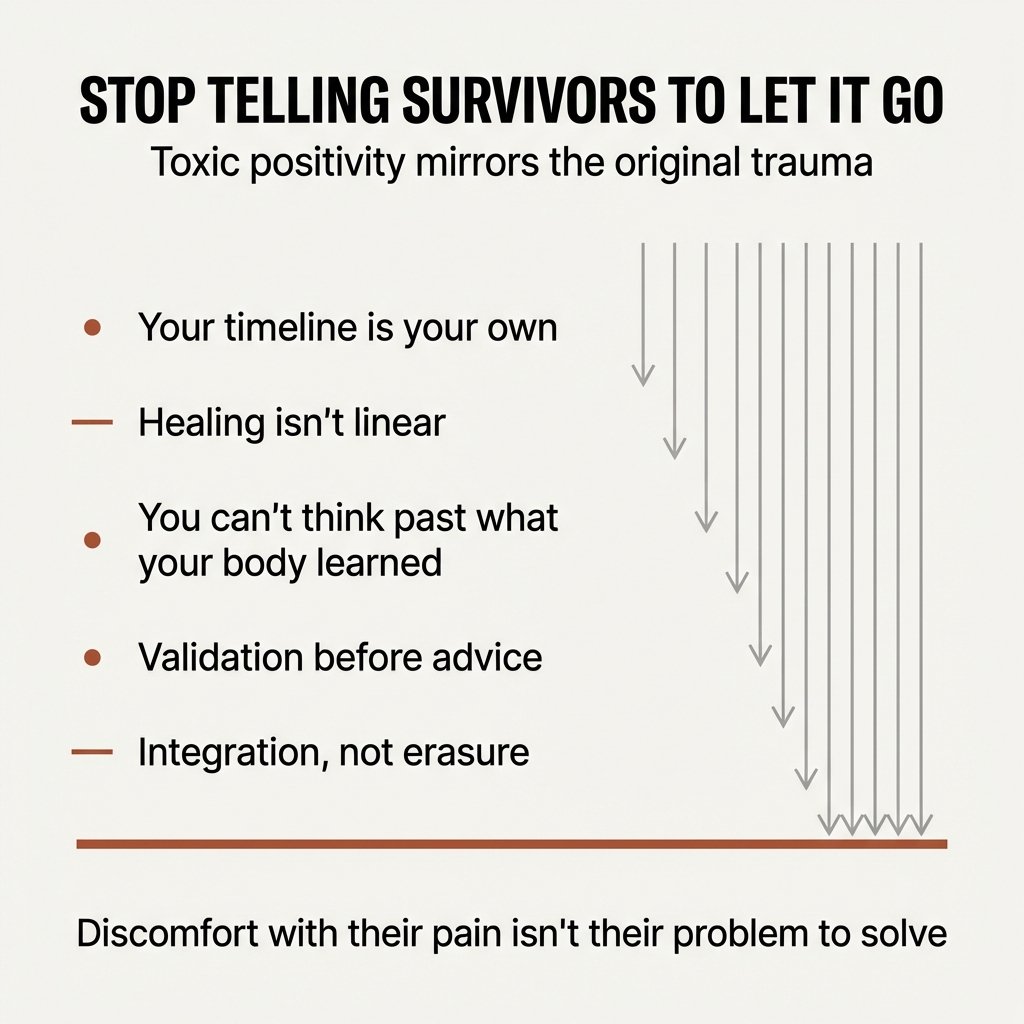
They need validation that their timeline is their own. That healing doesn’t follow a schedule. That setbacks don’t mean failure.

They need you to stop treating their pain like a problem you need to solve.

The most powerful thing you can offer someone in pain is presence without agenda. Listening without fixing. Witnessing without judgment.

This is uncomfortable. It requires you to sit with emotions you can’t resolve. It asks you to tolerate uncertainty and messiness.

But discomfort is not the same as harm. Your discomfort with someone’s pain is not more important than their need to process it.

Building a Different Kind of Healing Culture

We need a healing culture that makes space for the full spectrum of human experience.

One that doesn’t rush survivors through their grief to get to the inspirational part. One that doesn’t treat emotional honesty as negativity. One that understands the difference between hope and toxic positivity.

Real healing culture looks like this:

It validates before it advises. It asks what someone needs instead of assuming what they should do.

It recognizes that healing is non-linear. Progress includes setbacks, confusion, and days when you feel like you’re back at the beginning.

It makes room for anger. Survivors have a right to their rage. It’s information. It’s protection. It’s often the first sign that someone is starting to recognize what was done to them.

It doesn’t confuse boundaries with bitterness. Cutting off contact with an abuser isn’t holding a grudge. It’s self-preservation.

It stops treating forgiveness as a requirement. You don’t owe your abuser peace. You owe yourself safety.

It understands that some things can’t be let go—they have to be integrated. The goal isn’t to forget what happened. It’s to build a life where what happened no longer controls you.

What I Tell My Clients

When someone comes to me drowning in shame because they can’t seem to “just move on,” I don’t soften it.

I tell them the truth.

You’re not failing at healing. You’re succeeding at survival. Your nervous system is doing exactly what it was trained to do when staying alert to danger kept you alive.

The problem isn’t you. It’s that everyone around you is treating your protection mechanism like a personality defect.

You’re not stuck because you’re weak. You’re stuck because you’re trying to recover in the same environment that taught you to doubt your own reality.

Stop trying to let go. Start recognizing that your body remembers what your mind was forced to forget.

The work isn’t about releasing the past. It’s about learning to distinguish between actual threat and the echo of old danger. It’s about updating a survival system that’s still running on outdated code.

You don’t heal by pretending it didn’t happen. You heal by building a life where what happened no longer determines what happens next.

The past doesn’t need to be erased. It needs to stop being in charge.

The Bottom Line

Stop telling trauma survivors to let it go.

Start asking what they need. Start believing them when they tell you. Start sitting with the discomfort of not having a quick fix to offer.

Your discomfort with their pain is not their problem to solve.

Healing happens when we stop rushing people through their own experience and start creating space for them to move at their own pace. When we stop treating emotional honesty as negativity and start recognizing it as courage.

The survivors I work with don’t need rescue. They need recognition. They need permission to take as long as it takes. They need someone to stop telling them their timeline is wrong.

They need a healing culture that doesn’t gaslight them in the name of growth.

That’s what I’m building. That’s what we all should be building.

Because the people who survived the unsurvivable deserve better than being told to just get over it.

If you’re done waiting for permission to trust your own reality, book a one-on-one session. Let’s build the clarity you’ve been looking for.
New Beginnings

As this year closes,
I want to gently remind you of something important.
You do not have to drag every painful moment with you into the next chapter.
What happened mattered.
The grief mattered.
The disappointment mattered.
The lessons mattered.
But the weight of it all does not get to decide who you become next.
A new year is not about pretending you’re fine.
It’s about choosing not to live stuck in yesterday’s survival mode.
You’re allowed to lay down what exhausted you.
You’re allowed to release what hardened you.
You’re allowed to soften again, even if life taught you how not to.
This next season is about rebuilding trust with yourself. About choosing peace over proving. About curiosity over fear. About hope that is quiet, steady, and earned.
You don’t need to have it all figured out.
You don’t need a perfect plan.
You just need a willingness to believe that more is possible than what you’ve already lived through.
So here’s to the year ahead.
To fresh starts that don’t erase the past but are no longer ruled by it. To growth that feels lighter.
To joy that doesn’t require permission.
To optimism that finally feels safe to hold again.
You made it here.
That alone tells me the future has room for something better.

Happy New Year.

You’re Not Setting Boundaries, You’re Just Making Rules

Test Gadget Preview Image

You’ve heard it a thousand times. “I’m setting a boundary.” It sounds healthy. Empowered. Self-aware.

But here’s what most people miss.

Half the time, what you’re calling a boundary is actually a rule you want someone else to follow.

And the difference matters more than you think.

The Language Pattern That Gives It Away

Real boundaries and disguised rules sound completely different once you know what to listen for.

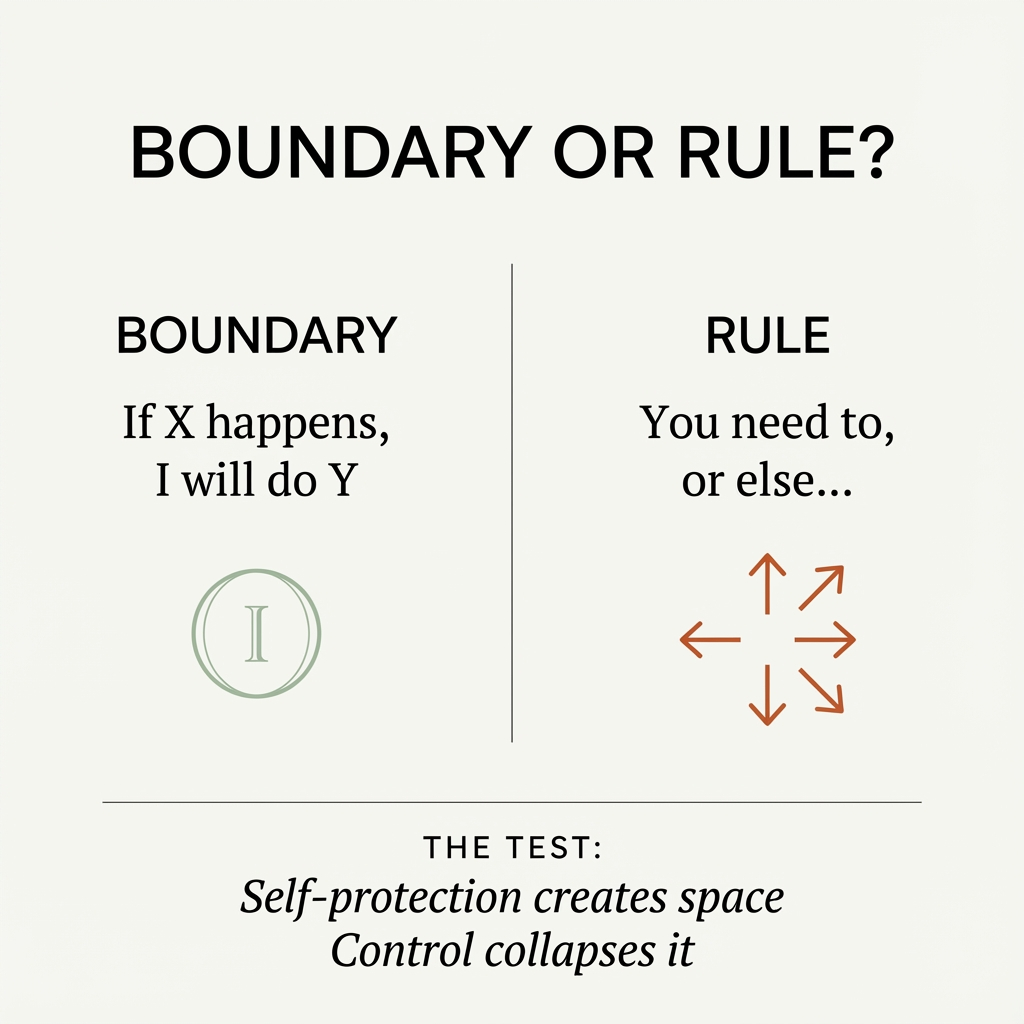
A boundary is self-referenced.
A rule is other-referenced.

That’s the core distinction.

When you’re truly setting a boundary, your language centers on your behavior, your limits, and your consequences. When you’re disguising control as a boundary, your language shifts responsibility onto the other person.

What a Real Boundary Sounds Like

A genuine boundary follows this structure: “If X happens, I will do Y.”

Examples:

  • “If I’m spoken to disrespectfully, I’ll end the conversation.”

  • “If plans are changed last minute, I won’t be able to attend.”

  • “I’m not available for conversations where I’m being yelled at.”

Notice what’s missing: no instructions, no policing, no demand that you change, no threat disguised as morality.

They’re simply stating what they will do to protect themselves.

What a Disguised Rule Sounds Like

A control-based “boundary” follows this structure: “You need to / You can’t / You have to, or else…”

Examples:

  • “My boundary is that you can’t talk to other people about this.”

  • “I’m setting a boundary that you need to respond faster.”

  • “My boundary is that you stop doing that.”

  • “If you cared about my boundary, you wouldn’t…”

This is not a boundary. It’s a behavioral mandate.

The giveaway is that their emotional regulation depends on your compliance.

The Mic-Drop Test

Here’s the cleanest way to spot it instantly.

Ask yourself: “If I don’t comply, are they describing what they will do, or punishing me for not obeying?”

  • If they adjust their behavior, it’s a boundary.

  • If they escalate, shame, withdraw, or threaten, it’s control.

Boundaries don’t require enforcement. Rules do.

What They’re Actually Protecting When They Enforce

When someone “enforces” a so-called boundary through escalation, shaming, or punishment, they’re not protecting themselves.

They’re protecting an internal structure.

Their Identity Narrative

They’re protecting the story they need to believe about themselves: I’m reasonable. I’m the victim. I’m the emotionally evolved one.

If you don’t comply, that identity cracks.

Enforcement becomes an attempt to stabilize the story, not the nervous system.

Their Sense of Control Over Emotional Safety

They don’t experience safety as something they generate internally.

Safety, to them, is predictability from others. Compliance. External regulation.

When you don’t comply, their system reads it as danger. Punishment becomes a way to re-establish control.

It’s not protection. It’s containment of their anxiety.

Avoidance of Internal Work

A real boundary requires tolerating discomfort, letting go of outcomes, accepting that others have autonomy.

That’s hard.

Rules avoid that work entirely. If they can make you responsible for their comfort, they never have to sit with insecurity, jealousy, fear of abandonment, or powerlessness.

Enforcement is avoidance with a moral label.

Their Role in the Dynamic

They’re protecting the role you play for them: the regulator, the validator, the mirror that confirms their worth, the stabilizer of their emotions.

If you step out of that role, enforcement pulls you back in.

The punishment isn’t about the behavior. It’s about restoring the function you serve.

Self-protection creates space. Control collapses space.

The Codependency Mirror You Don’t Want to See

Here’s the uncomfortable truth.

Someone who survives narcissistic abuse doesn’t automatically heal the function they were trained to perform. They often just change the language around it.

The behavior looks different. The vocabulary sounds healthier. But the role is the same.

Survival Skills Get Rebranded, Not Released

In narcissistic dynamics, you learn early and deeply: My safety depends on managing someone else’s emotional state.

That creates a role: regulator, stabilizer, emotional translator, peacekeeper.

When you leave the abusive dynamic, that role doesn’t disappear. It goes underground.

Instead of appeasing, people-pleasing, walking on eggshells, it morphs into “healthy communication,” “boundaries,” “emotional standards,” “trauma-informed language.”

Same nervous system job. New dictionary.

Why the Role Gets Recreated

Control felt like safety back then.

If you could anticipate moods, soothe reactions, prevent explosions, manage outcomes, you stayed safer.

Your nervous system learned: Regulation equals control.

So later, when someone doesn’t behave predictably, your body doesn’t think “This is uncomfortable.” It thinks “This is dangerous.”

The old skillset activates automatically.

Healing without detaching the role.

Many survivors do cognitive healing first: therapy language, insight, awareness, concepts. But the somatic attachment wiring is still intact.

So instead of saying “I need you to calm down or else,” it becomes “I’m setting a boundary around this energy.”

The behavior hasn’t changed. Only the justification has.

Identity whiplash.

After narcissistic abuse, there’s often a swing from silenced, minimized, controlled to hyper-sovereign, hyper-defensive, hyper-protective.

Boundaries stop being self-containment and start becoming territorial control.

Why? Because power feels like safety after powerlessness.

The Brutally Honest Truth

Most people who leave narcissistic abuse are not healed of relational control.

They’re healed of being controlled.

Those are not the same thing.

Without deep integration work, you can unconsciously become emotionally rigid, outcome-attached, regulation-dependent, intolerant of autonomy.

Just like the dynamic you escaped. Different flavor. Same mechanism.

Healing happens when you can say: “I can be dysregulated and still let you be autonomous.”

What the Shift Actually Looks Like

This is where theory either becomes lived or stays cosmetic.

Someone you care about does something that triggers you. They don’t respond how you hoped. They set a limit. They disagree.

Your body reacts first. Chest tightens. Heat in the face. A surge of urgency.

This isn’t okay. I need to fix this.

Old reflex: reach out, correct, clarify, explain, enforce, reframe it as a boundary.

The Fork in the Road

There is a 2–5 second window right here. Not long. But it exists.

The question is not “What should I say?”

It’s: “Am I trying to regulate myself or regulate them?”

That question alone interrupts the loop.

Step 1: Name the Truth Internally

Not “I’m setting a boundary.”

But: “I am dysregulated right now and I want relief.”

That honesty matters. No self-shaming. No spiritual bypass. Just truth.

Step 2: Allow the Sensation Without Action

This is the hardest part.

Instead of sending the message, enforcing the boundary, withdrawing to punish, explaining yourself into safety—you pause.

You let the sensation exist without resolution.

You might say internally: “This feels unbearable, but it is not dangerous.”

Your nervous system hates this. That’s the point.

Step 3: Separate Discomfort from Threat

Here’s the reframe that changes everything:

“I feel unsafe because I’m attached to an outcome, not because something bad is happening.”

That sentence dissolves entitlement to compliance.

You stop telling yourself “They’re being unfair” or “They’re violating me” and start telling the truth: “I don’t like this, and I don’t get to control it.”

Step 4: Choose Containment Over Control

Instead of doing something to them, you do something for yourself.

You put the phone down. You step outside. You breathe slower than your urge. You move your body. You sit with the urge without discharging it.

This is not repression. This is capacity building.

You’re teaching your system: “I can survive not being soothed.”

Step 5: Let the Outcome Be Uncertain

This is where the old self would enforce.

The healed self says: “I don’t know how this will turn out. And I’m staying present anyway.”

No chasing. No punishing. No moralizing. Just tolerance.

Healing is not calm. Healing is staying when you want to control.

What Makes the Pause Possible

The pause is not a personality trait. It’s a capacity.

Most people don’t lack insight. They lack nervous system bandwidth.

Their Nervous System Has Learned That Discomfort Is Survivable

For people who can pause, their body has already learned this truth: “Nothing terrible happens if I don’t act immediately.”

That learning didn’t come from insight. It came from repeated, embodied experiences of staying in discomfort and surviving it.

Without that history, your system fires: Act now or die.

They’ve Lost Faith in Urgency

People who can pause no longer believe urgency equals truth, intensity equals importance, or discomfort equals danger.

They’ve been wrong too many times.

Their system has learned: “Every time I rush to fix this, I make it worse.”

They Don’t Need the Other Person to Regulate Them Anymore

People who can’t pause still depend on reassurance, agreement, responsiveness, compliance to settle their system.

People who can pause have internalized regulation enough that relief does not require someone else changing.

That removes the chase reflex.

They Can Feel Shame Without Collapsing

The pause often opens with shame: I’m wanting to control right now. This isn’t about them. I’m attached to an outcome.

People who can’t tolerate shame discharge it outward through blame, righteousness, moral language, enforcement.

People who can tolerate shame can stay still long enough to choose.

The pause lives on the far side of shame tolerance.

Where to Actually Start

If you realize you’ve been making rules and calling them boundaries, here’s the first structural change.

You stop using other people as your primary regulation strategy.

Not emotionally. Not morally. Not relationally. Practically.

End Outcome-Leverage

When people turn rules into “boundaries,” they’re attaching their sense of safety to a specific outcome: you responding a certain way, you agreeing, you staying emotionally close.

The rule exists to force the outcome.

The first structural change is to remove outcome leverage entirely.

Old architecture: “I’m not okay unless this goes the way I need.”

New architecture: “I am responsible for staying regulated regardless of the outcome.”

Stop Announcing Boundaries Mid-Activation

Most rule-based “boundaries” are declared while dysregulated.

That trains your system to believe: “I only feel safe if I externalize control.”

So structurally, you stop doing this. Instead, you take space without explanation. You delay communication. You do not define, clarify, or correct in the moment.

This feels unbearable at first. That’s withdrawal from enforcement.

Build a Personal Regulation Protocol

People who don’t enforce boundaries have ritualized self-regulation. Not affirmations. Not insight. Physical, repeatable actions.

For example:

  • Walk before responding

  • Cold water on wrists or face

  • Breath pacing longer than the urge

  • Movement until sensation shifts

  • Writing without sending

This becomes the new containment structure. The rule was doing this job before.

Replace “You Can’t” With “I Will”

Not just in language. In behavior.

Old structure: “You can’t talk to me like that.”

New structure: “If this continues, I will step away.”

And then you actually do. No explanation. No punishment. No moral charge.

This retrains your nervous system to trust self-execution, not compliance.

Allow the Relationship to React Without You Managing It

When you stop enforcing, some people escalate. Some withdraw. Some reveal dependence. Some stabilize.

You do nothing to correct their reaction.

Why? Because internal architecture requires this belief to land somatically: “I do not need to manage other people’s responses to be safe.”

“I don’t need this to go my way to stay with myself.”

What Happens to Relationships

When you stop enforcing and start removing yourself, relationships don’t fail randomly. They sort.

What Breaks

Relationships built on regulation roles.

These are relationships where you were unconsciously assigned a job: emotional stabilizer, conflict diffuser, meaning translator, reassurer.

When you stop enforcing and simply remove yourself, the other person feels uncontained. Their response often looks like escalation, moralizing, panic, rage.

What’s breaking here is not intimacy. It’s dependence.

Bonds sustained by fear of rupture.

Some relationships only felt close because someone was always preventing collapse. When you stop doing that, silence stretches, awkwardness appears, distance grows. And no one repairs it.

Not because repair is impossible, but because repair was never mutual.

Dynamics where compliance was confused for love.

If your “yes” was how safety was maintained, your neutral absence will feel like rejection. These connections often end with accusations of coldness, rewriting of your intentions, character attacks.

That’s not about you leaving. It’s about the system losing control.

What Survives

Relationships with internal regulation on both sides.

In healthy relationships, when you remove yourself instead of enforcing, the other person pauses too. They self-reflect. They don’t chase, punish, or escalate. They respect the space without resentment.

There may be discomfort, but not chaos. These relationships often deepen after the shift.

Bonds that can tolerate uncertainty.

Some relationships survive because they were never built on predictability. They were built on choice, goodwill, curiosity, flexibility.

When enforcement stops, these people don’t interpret it as abandonment. They interpret it as: “They’re taking care of themselves.”

How You Tell the Difference

When you stop enforcing and start removing yourself, watch what fills the space.

If the space fills with curiosity, self-reflection, respect, patience: The relationship is viable.

If the space fills with blame, panic, punishment, narrative control, character attacks: The relationship was dependent, not relational.

No amount of enforcement would have made it healthy.

The Lonely Middle Phase

You will feel lonelier at first, even in healthier relationships.

Why? Because predictability creates a false sense of closeness. Autonomy creates real distance. That distance is what allows choice to return.

But here’s the question: How do you know you’re building architecture and not just becoming avoidant or emotionally detached?

The Core Distinction

Avoidance uses distance to escape feeling.
Architecture uses distance to stay with feeling without outsourcing it.

Same behavior. Opposite function.

The diagnostic isn’t “Am I stepping back?” It’s “What am I doing with myself while I’m back here?”

What Avoidance Feels Like Internally

Avoidance feels like relief first. There’s a shutting down. A flattening. A sense of “I don’t care anymore.”

Common markers:

  • Emotional numbness or fog

  • Justification narratives: “I don’t need anyone”

  • A subtle superiority or detachment stance

  • Rapid replacement behaviors: distractions, new attachments, busyness

  • No grief, just dismissal

Avoidance distances from vulnerability. It creates safety by shrinking contact with feeling itself.

What Architecture-Building Feels Like Internally

Architecture feels worse before it feels better. There is no numbness. There is exposure.

Common markers:

  • Loneliness that’s sharp, not hollow

  • Grief without a clear target

  • The urge to reach out, explain, fix, enforce

  • Anxiety without immediate discharge

  • A constant pull to abandon the process

You are not detached. You are present without relief.

Architecture distances from control, not from connection. That’s why it hurts.

The Most Reliable Test

Ask yourself honestly:

“Am I unavailable to avoid discomfort, or am I available to my discomfort without making it someone else’s job?”

Avoidant distance says: “I don’t want to feel this.”

Architectural distance says: “I am feeling this, and I’m staying.”

One collapses feeling. The other metabolizes it.

What Happens to Desire Is the Tell

In avoidance: Desire goes offline. People become interchangeable. Connection feels optional or burdensome.

In architecture: Desire remains, but you don’t chase it. You miss people without pursuing them. You feel longing without turning it into action.

Avoidance kills longing. Architecture contains it.

The Relationship Signal

If someone reached out respectfully tomorrow, would your system tense and want to disappear, or feel activated but open?

Avoidance forecloses possibility. Architecture leaves the door unlocked without standing in the doorway.

If distance makes you smaller, it’s avoidance. If distance makes you sturdier, it’s architecture.

The Final Truth

A boundary says: “This is what I will do to care for myself.”

A rule says: “This is what you must do so I don’t have to.”

Once you hear that shift, you can’t unhear it.

Enforcement preserves relationships by force. Removal preserves self-respect.

The relationships that survive self-respect were always real. The ones that don’t were only stable because someone kept holding the structure up.

Letting them fall is not abandonment. It’s gravity doing its job.

The lonely middle is not where you disappear. It’s where your internal load-bearing walls get built.

And yes, it’s supposed to feel quiet, exposed, and unspectacular.

That’s how you know it’s real.

You’re Not Attracting Unavailable People: You Are One

Test Gadget Preview Image

;When someone tells me they’re ready for a real relationship but their dating history reads like a catalog of emotionally unavailable partners, they’re not describing readiness.

They’re describing a familiar nervous system.

What they’re unknowingly revealing: They equate intensity with connection. They’re more practiced at chasing than choosing. They feel chemistry most strongly where safety is absent.

This isn’t a character flaw. It’s conditioning.

Readiness Is a Behavioral Pattern, Not a Declaration

If you were truly ready for a healthy relationship, your dating history would include people who were available, consistent, and capable of repair, even if those relationships didn’t work out.

Instead, what I usually see is someone who says they want intimacy but keeps selecting partners who make intimacy impossible.

That’s not bad luck. That’s alignment with an unhealed attachment wound.

What you’re really saying: “I want connection, but my nervous system only recognizes love when it feels like uncertainty, distance, or emotional work.”

You pursue emotionally unavailable partners not because you want chaos, but because calm feels foreign. Safety doesn’t register as chemistry yet.

What Happens When You Sit Across From Someone Available

When your nervous system is calibrated to uncertainty and you sit across from a genuinely available person, nothing is wrong with them.

What’s happening is an internal mismatch.

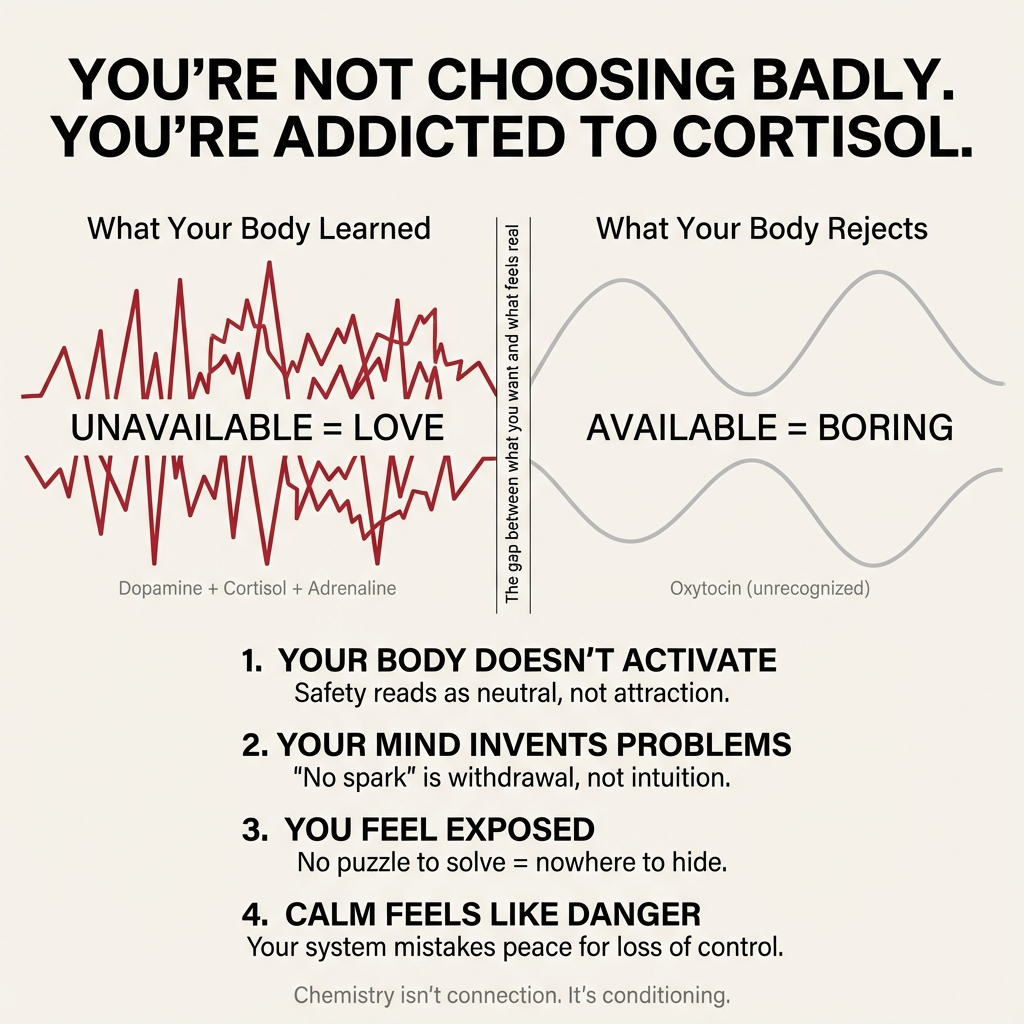
First, your body doesn’t activate. There’s no spike. No charge. No adrenaline. No hyperfocus. The nervous system that learned love through inconsistency expects tension as proof of importance. Availability doesn’t create tension, so your body reads it as neutral. Neutral gets mislabeled as boredom.

Second, your mind goes searching for a problem. Because your body isn’t lit up, your brain fills in the gap. Thoughts start surfacing like “I don’t feel a spark” or “Something’s missing” or “They’re nice, but…” or “They’re great on paper, but I’m not excited.”

That’s not intuition. That’s withdrawal from a stimulus your nervous system is addicted to.

Third, there’s a subtle sense of exposure. With an emotionally available person, there’s nowhere to perform, chase, prove, or earn. No emotional puzzle to solve. No distance to close. When someone sees you clearly and is still present, your nervous system doesn’t feel rewarded. It feels unmasked.

Fourth, your body interprets safety as loss of control. In chaotic dynamics, control comes from hypervigilance. You’re scanning, adjusting, earning. With availability, that role disappears. Your nervous system mistakes the absence of vigilance for danger.

So instead of leaning in, you disengage. You intellectualize. You stall. You friend-zone. You say “I just don’t feel it.”

What you’re actually feeling is detox.

The Addiction Loop You’re Stuck In

You’re experiencing the absence of cortisol and dopamine loops you’ve associated with love. Your system hasn’t learned yet how to register oxytocin as attraction.

Here’s the part that matters most. If you leave that situation, you’ll likely feel a sudden rush of longing later. Not because the person was wrong, but because distance reactivates the familiar signal. The moment safety is gone, desire returns.

That’s the addiction loop.

This is why you swear you “lost feelings” for healthy partners and then feel obsessed with unavailable ones. You didn’t lose feelings. You lost stimulation.

Until you retrain your nervous system, availability will feel underwhelming and unavailability will feel magnetic. Not because that’s love, but because that’s what your body learned to survive.

That’s the difference between chemistry and conditioning.

The Structural Rewiring Process

Awareness is diagnostic, not corrective. You keep mistaking insight for intervention. The pattern doesn’t break because it’s not a belief problem. It’s a conditioning problem.

Conditioning only changes through structure, not willpower.

The dopamine-cortisol loop has to be interrupted long enough for withdrawal to complete. Unavailability creates a biochemical cocktail. Dopamine from anticipation, cortisol from uncertainty, intermittent reinforcement from inconsistent reward. The loop doesn’t dissolve because you understand it. It dissolves when you stop feeding it.

Structurally, this means prolonged disengagement from activating dynamics. Not dating better people on the side. Not keeping emotionally unavailable exes in orbit. Not rehashing old connections for emotional hits.

Your nervous system needs sustained absence of the stimulus to downregulate its baseline.

Until withdrawal completes, availability will always feel flat because your system is still calibrated to a higher intensity threshold.

Your body has to learn safety through repetition, not logic. Safety doesn’t register as pleasure at first. It registers as neutrality. Sometimes even discomfort. The work isn’t to “feel chemistry.” You need to stay present long enough for your body to update its map.

That means tolerating the urge to self-sabotage when nothing is wrong. Sitting through dates that don’t spike adrenaline. Letting consistency feel boring without labeling it wrong.

Repeated exposure to non-activating connection teaches your nervous system that calm does not equal danger or loss.

The Grief Nobody Talks About

You have to grieve intensity as identity.

For many people, intensity wasn’t stimulation alone. It was identity. “I’m passionate.” “I feel deeply.” “I love hard.”

What you’re grieving is the loss of a role where suffering equaled meaning. When availability enters, the identity collapses. There’s no dramatic arc. No emotional heroism. No highs and lows to narrate.

Until you grieve the loss of that identity, you’ll keep reaching for dynamics that let you feel alive through struggle. Availability will feel flat because it doesn’t confirm who you think you are.

This grief isn’t sentimental. It’s existential.

When the Calm Arrives and You Want to Sabotage It

When the urgency softens around day four or five of no contact, you don’t feel triumphant. You feel emptied out. The adrenaline is gone. The obsession quiets. The charge drops.

Instead of interpreting this as regulation, you interpret it as loss of self.

The most common justification: “I guess this means I never cared.”

That thought is lethal.

What you’re experiencing is the absence of dysregulation, but your mind translates the absence as emotional death. If intensity has been your proof of attachment, calm feels like indifference. You panic and try to resurrect feeling, not connection.

The second justification is more seductive. “I’m in a healthier place now. I handle it differently.”

This is the relapse fantasy.

You mistake nervous system regulation for resilience. You assume that because the urge has softened, you’re now strong enough to re-enter the dynamic without getting hooked. You don’t realize the stimulus hasn’t changed, only your distance from it.

You test yourself. One text. One check-in. Closure.

The moment you re-engage, the loop snaps back online. Dopamine floods. Cortisol spikes. Your body lights up. You say, “See? There it is. That’s how I know it’s real.”

What you don’t see: you reintroduced the drug and mistook the hit for love.

How to Tell the Difference Between Rewiring and Forcing It

Someone reaches that point where they finally feel present instead of pursuing. Then a genuinely available person shows up.

You can force availability just as hard as you once chased distance.

I don’t tell people, “If it’s calm, it’s right.” That’s lazy and dangerous. I teach them how to tell the difference in the body over time, not in a single date or feeling state.

Calm versus collapse: When your body isn’t used to availability, you feel neutral but present. You’re curious. You can stay in the interaction without checking out. Your breath is steady. You might think, “I don’t feel swept away, but I feel like myself.”

When someone is wrong for you, your body doesn’t just feel calm. It feels collapsed. There’s a subtle constriction. You’re polite but not engaged. Time drags. You feel smaller, dulled, or slightly irritated.

Ask yourself this. “Do I feel more like myself with them, or less?” Not more excited. More yourself.

Curiosity grows or curiosity dies: With a healthy, available person during rewiring, attraction is often delayed but expanding. You find yourself wanting to know them more. You replay moments not with obsession, but with warmth.

With someone you’re forcing, curiosity flatlines. There’s no internal movement. You’re not wondering about them. You’re evaluating them.

Healthy attraction grows. Forced attraction stagnates.

Your nervous system response after contact: After spending time with a genuinely healthy match during rewiring, you feel regulated afterward. Not euphoric, but settled. There’s no crash. No rumination. No self-critique.

After time with someone who’s wrong, even if they’re available, there’s often low-grade agitation or depletion. A sense of effort. Subtle resentment.

Stop asking, “How did I feel with them?” Start asking, “How did I feel after?”

Your body tells the truth there.

The Truth You Don’t Want to Hear

You don’t become ready for a healthy relationship by wanting one badly enough.

You become ready when you can tolerate consistency without trying to earn it. When you stop mistaking potential for partnership. When you can walk away from someone who activates you instead of choosing them because they do.

Until then, “I’m ready” is often just another way of saying, “I’m tired of being hurt, but I haven’t changed the pattern that keeps hurting me.”

The shift isn’t “I choose availability no matter what.”

The shift is “I trust my body again, now that it’s no longer addicted to chaos.”

That’s when going back stops feeling tempting and starts feeling expensive.

Becoming Yourself Again After a Relationship Ends

Test Gadget Preview Image

You didn’t lose yourself by accident.

I know the language feels comforting, but it’s wrong. What happens in relationships, especially narcissistic ones, isn’t some mysterious vanishing act. It’s identity erosion.

Mechanical. Predictable. Systematic.

Here’s how it starts: The relationship slowly replaces your internal authority with external permission. You still know who you are at first, but you start checking yourself. Editing your tone. Rehearsing conversations in your head.

You stop asking, Is this true for me?

You start asking, How will this land?

That’s the first fracture. Your inner compass doesn’t disappear. It just stops being trusted.

The Self Is Not Destroyed, It’s Disowned

Here’s what people don’t want to hear:

Your self isn’t destroyed during identity erosion. It’s disowned.

This changes everything about how you heal.

Healing isn’t about finding yourself again. That phrase implies you vanished. You didn’t. You’re still here. Healing is about reclaiming internal authority, rebuilding trust with your own perception, and learning to tolerate the discomfort of being disliked, misunderstood, or unmet without abandoning yourself to manage things.

When you’ve been disowned from yourself, your internal hierarchy flips upside down:

• Other people’s reactions sit at the top
• Safety, approval, harmony run the system
• Your own perception gets buried at the bottom
• You treat your instincts as unreliable, dramatic, dangerous

So where do we start rebuilding?

The foundation I rebuild is this:

“My perception is primary data.”

Not correct. Not perfect. Not unquestionable.

But primary.

Before we touch emotions, we reestablish what I call epistemic sovereignty. This means recognizing your thoughts, sensations, instincts, and reactions are information. Not problems to be fixed. Not noise to filter through someone else’s comfort level.

Information.

What does this look like when it starts coming back?

When Epistemic Sovereignty Returns

Reclaiming ownership of perception doesn’t look like confidence at first. It looks like quiet interruption of an old reflex.

Watch for this specific pattern:

You still doubt yourself at first, but you stop overriding the doubt automatically.

Before: perception → self-doubt → self-erasure → justification

Now: perception → doubt → pause

The pause is everything.

It’s the moment you don’t immediately reach for reassurance. You don’t text someone to check if you’re crazy. You don’t mentally rehearse how to explain yourself better. You don’t pre-invalidate what you just noticed.

You simply let the perception exist without prosecuting it.

Another sign sovereignty is returning?

Your internal language shifts. You stop asking, “Was this wrong for me to feel?” You start asking, “Why did I feel this?”

This question shift is structural. It moves perception from something needing permission to something deserving investigation.

Once you’ve reclaimed perception, the next phase begins.

Boundaries Are Architecture, Not Negotiation

Once perception is reclaimed, boundaries do not start as statements.

They start as structural decisions.

Most people think boundaries fail because they weren’t firm enough or clear enough. Wrong. Boundaries fail because you’re still using them as a communication strategy instead of a containment strategy.

A real boundary answers one question only:

What am I no longer willing to participate in?

Here’s the difference:

Not a boundary: “I need you to stop dismissing my feelings.”
This is a request for internal change in another person. Architecturally weak.

A boundary: “I don’t stay in conversations where my experience is dismissed.”

See the shift? No persuasion. No emotional appeal. No outcome management.

Just jurisdiction.

When boundaries get crossed, here’s what changes:

Old pattern: Perception → explanation → escalation → self-betrayal

New pattern: Perception → action

No speech required.

You leave the room. End the call. Pause contact. Change your availability.

When you act without narrating, arguing, or convincing, the boundary holds.

But here’s where most people get stuck…

Dealing While Healing

Rebuilding yourself and grieving the relationship aren’t sequential processes.

They’re parallel systems.

The mistake? Believing grief must resolve before life resumes. This belief keeps you suspended, loyal to what harmed you, quietly self-abandoning under the banner of processing.

Here’s the truth:

Grief doesn’t mean collapse. It means integration under load.

When you’re grieving a relationship while it dismantles you, two things happen simultaneously:

1. Your nervous system detoxes from attachment
2. Your identity rebuilds without the relational mirror it depended on

The timeline matters:

• Delay rebuilding while grieving → grief becomes identity
• Rebuild while grieving → grief becomes a passage

You don’t need closure to move forward.

You need containment.

What does this look like in practice?

You miss someone and still don’t allow access.
You love someone and still don’t negotiate reality.
You grieve deeply and still enforce boundaries cleanly.

People confuse emotional truth with behavioral obligation. They’re not the same.

Feeling sad doesn’t mean reaching out.
Feeling longing doesn’t mean reopening contact.
Feeling grief doesn’t mean suspending self-protection.

Emotions get expression.

Behavior gets discernment.

You feel everything. You don’t act on everything.

This is how you deal while healing. But how do you make sure you don’t repeat the pattern?

Pattern Literacy Prevents Repetition

What prevents cycling back into the same dynamics is pattern literacy.

Not insight. Not vows. Not better partners.

Pattern literacy.

Here’s how to tell the difference between someone who’s performed recovery versus someone who has pattern literacy:

Performed recovery: Still feels most alive in intensity. Intellectualizes things better. Says things like, “I’m aware of my triggers now” or “I’m taking this slow.” But their body is still pulled toward activation.

Pattern literacy: Attraction cues recalibrate completely.

• Intensity no longer reads as chemistry
• Chaos no longer reads as depth
• Urgency no longer reads as fate

Those sensations register as information.

Your nervous system flags intensity early, not with panic, but with neutrality:

“This feels familiar. Not necessarily safe.”

Not avoidance.

Literacy.

People with pattern literacy understand early discomfort isn’t a red flag or a green flag. It’s a diagnostic tool.

They don’t rush to resolve things.
They don’t collapse into self-blame.
They don’t escalate intimacy to escape.

They slow down and observe.

The pause breaks cycles.

And here’s what pattern literacy feels like…

Pattern literacy is quiet.

Boring, even.

Doesn’t feel like winning. Doesn’t feel like chemistry.

Feels like self-respect without adrenaline.

Which is why people who haven’t healed think this is settling. But it’s not.

It’s stability without self-erasure.
Connection without activation.
Intimacy without collapse.

The difference shows up in what you tell yourself:

Performed recovery says: “I won’t let this happen to me again.”

Pattern literacy says: “I’ll recognize this before recovery is required.”

Once you have pattern literacy, you don’t cycle back.

Not because you’re stronger.

Because the pattern no longer speaks the same language to your nervous system.

That’s when the work is complete.

From Wounds to Wisdom: Crafting a Legacy of Light

Good Morning

Before we begin, I want to share something deeply personal with you. It’s a letter I wrote to my son, Canon. It’s for him to read one day, when I’m no longer physically here. It begins…

“My sweet Canon,
There’s no map for what I’m about to say because the path we’ve walked together was never paved with easy choices or straight lines. It was built on fight, fire, and faith.
If you’re reading this, it means we’ve come to that part of the story where I step out of sight… but I never step out of your life. Not even for a second.
You are my greatest legacy.
Not my degrees.
Not my books.
Not my healing rooms.
You.”

I start here, with you: my fellow healers, counselors, coaches, and ministers; because I know you understand this in your bones. I know that the work we do isn’t a job. It is a calling. It is a sacred ache to create something that outlives us. It is the deep, cellular knowing that our true legacy will not be measured in accomplishments, but in the love, we give, the patterns we break, and the light we pass on.

This morning, we are going on a journey together. It is the most sacred journey a human being can take: the path from our deepest wounds to our most profound wisdom. We will explore how this personal transformation is the only true foundation for the legacy of light we are all here to build.

The Unseen Self: Recognizing the Landscape of Trauma

Before we can ever hope to guide another soul through the dark, we must first become intimate with our own inner landscape. The path requires us to map the territory of our own trauma; the patterns, the beliefs, and the brilliant survival mechanisms that have shaped us. This self-awareness isn’t just a tool for a healer; it is the tool.

Defining the Disconnection

On our path, we come to understand that we each have two selves. There is the True Self-our Divine Essence, the eternal, unchanging part of us that is one with Source. And then there is the ego self—the fear-based, reactive identity born from the illusion of separation. Trauma creates a profound disconnection from our True Self. It’s a spiritual injury that forces us, for the sake of survival, to identify with our wounds instead of our wholeness. We forget who we truly are and begin to believe we are the pain we have endured.

The Echoes of Pain

There is a truth that saved me, and it is this: “What doesn’t heal, repeats.” Unhealed trauma doesn’t just stay in the past; it echoes into our present. This disconnection from our True Self creates a void, and one of the most common ways we try to fill it is through what we call “love addiction.”
This is where unresolved relational trauma causes us to unconsciously crave chaos because it feels familiar. We begin to “mistake intensity for intimacy,” chasing partners and situations that re-enact our original wounds. It is a perfect, painful example of the shadow trying to protect us by recreating what it knows, all while believing we are searching for love.

The Survival Capsule

For so long, we were taught to see the hidden parts of ourselves-our shadow-as something monstrous to be defeated. But I want to offer you a new perspective, one filled with compassion. The shadow is not a monster; it is a survival capsule. When you endured trauma, pushing parts of yourself into the dark—your anger, your needs, your vulnerability-was not a sign that you were broken. It was an act of intelligent survival. You packed away everything that was unsafe to express, and you kept yourself alive.

This survival capsule is what keeps us identified with the ego self. It’s why we forget our Spiritual Power and believe our prosperity is limited. The journey back isn’t about destroying the capsule; it’s about remembering the True Self that was powerful enough to build it in the first place.

The Compass of Truth: Reclaiming Your Authentic Power

The truths I am about to share are not abstract theories. They are a practical, powerful compass for navigating the journey back to yourself. They are the source of authentic power that allows us to move beyond mere survival and into the conscious co-creation of a life aligned with our soul.

Redefining Power and Prosperity

We’ve been taught to see power as force and control but the truth that sets us free is this: Spiritual Power is the inner force we derive from our conscious alignment with Divine Source. It doesn’t control; it uplifts, heals, and transforms through love.

Similarly, we are taught that prosperity is about wealth. But on our path, we come to know that true Prosperity is a “State of Soul.” It is a holistic sufficiency in health, purpose, relationships, and peace that radiates from within when we are attuned to our spiritual power. It is not something you get; it is something you remember you are.

The Mind as the Builder

Our mind is the creative faculty of the soul, the bridge that connects the formless realm of Spirit to the world of form. This happens through a partnership between the two parts of your mind:

  • The conscious mind is the chooser, the gardener that selects the seeds of thought.
  • The subconscious mind is the garden, the fertile soil that manifests whatever is planted within it.

This is why mastering our dominant thoughts is the key to creating a new reality. The universal law is unwavering: “what you hold in mind will eventually manifest in form.” When we consciously plant thoughts of wholeness, abundance, and love, our reality has no choice but to reflect that truth back to us.

The Source of Healing

Perhaps the most empowering truth of all is this: all healing is self-healing. As healers, we are not here to “fix” anyone. Our sacred role is to facilitate, to hold space, to remind others of a truth they have temporarily forgotten. True healing is the restoration of our alignment with the “Healing Presence” within us-the divine blueprint of perfect health that is our natural state. Our job is to help our clients remember the wholeness that already exists within them, just waiting to be reactivated.

With these truths as our compass, we can now turn to the courageous work of putting them into practice.

The Work of Illumination: A Healer’s Sacred Toolkit

A compass is useless if you are not willing to walk the path. This section is about the practical, courageous work required to illuminate the unseen parts of ourselves. And let me be clear: these are the sacred tools we must first use on ourselves before we can ever authentically guide others. This is the non-negotiable work of integrity.

The Core Practice: Shadow Work

This next part is where the real work begins. It’s not easy, but I know the cost of avoidance, and I know you do, too. We have to be willing to turn and face what we’ve hidden in the dark. This is Shadow Work: the courageous and compassionate process of turning to see what lies within us not to banish it, but to understand and integrate it.

This work is most powerfully done in community. The shadow thrives in isolation, but in “The Circle,” it can be healed. A well-facilitated circle provides a container of:

  • Safety: A space where vulnerability is honored.
  • Witnessing: The profound healing that comes from being seen without judgment.
  • Perspective: Hearing others’ stories, which allows us to see our own patterns with fresh eyes.

Deconstructing Spiritual Bypassing

In our field, there is a dangerous pitfall where spirituality is used to avoid, rather than heal, our pain. This is spiritual bypassing, and it often appears as Toxic Positivity or Denial. The antidote to both is Radical Acceptance.

Avoidance TacticThe Pitfall (What it is & What it sounds like)Authentic Healing (Radical Acceptance)
Toxic Positivity (The Mask)It’s slapping a smiley face sticker over a bullet wound. Invalidates authentic emotion. Sounds like: “Just stay positive!”Acknowledges that you can hold multiple truths at once. Example: “I can be grateful and still be grieving.”
Denial (The Blindfold)It’s pretending the bullet wound doesn’t exist at all. Blocks all insight by refusing to see a painful reality. Sounds like: “It’s not that bad.”Holds space for the truth of a feeling or situation without shame. Example: “This feeling is valid and deserves my attention.”

Healing is when you remove both—face the mirror—and get honest about what hurts.

Uncovering the Gold

The most empowering part of this work is discovering what Carl Jung called the Golden Shadow. This refers to the brilliant, positive traits and untapped potential we suppress because we were told we were “too much”—too loud, too smart, too passionate, too bold. We often project this gold onto others. The people you admire, the leaders you idolize… But what if I told you the reason you’re drawn to those people is because they are reflecting your own hidden brilliance back to you? The work here is to stop projecting and start reclaiming. It is to finally own the light, the leadership, and the power that has been yours all along.

When we commit to this sacred work, we become healers who have walked the path ourselves—healers who are ready to build a truly lasting legacy.

The Legacy of Light: Becoming the Lighthouse

Our personal healing is not the final destination. It is the fuel. It is the raw material from which we build our ultimate purpose: to become a beacon for others and to leave behind a legacy of light that ripples out long after we are gone.

The True Inheritance

I want to circle back to that letter to my son. I told him that his greatest inheritance was not my achievements, but the “fire” he carries in his bones. That is the legacy we are here to build. It’s the resilience, the wisdom, and the love that we embody so fully that it gets passed down through generations. It is the story they will tell. As I wrote to him, “Tell your children about the woman who never gave up.” Tell them I was a bit wild. A bit witchy. A bit too honest. That is the inheritance that changes the world.

The Healer’s Ultimate Calling

I challenge you today to see your work through this lens of legacy. As a Metaphysical Minister, a counselor, a coach, your highest calling is not to have all the answers. It is to serve as a “lighthouse for those in dark nights of the soul.” Your purpose is to be a walking, breathing example of what is possible. It is to turn your own scars into a map that shows others the way home to themselves.

Final Call to Action

So I leave you with the same mandate I leave for my own blood, the same charge I live by every single day. This is why you are here.

You’re not here to be small, polite, or perfect.

You’re here to shatter patterns.

To break generational chains.

To speak truth into places where silence used to live.

This work is not easy, but you were built for it. And you are not alone.

You’ve got this. And you’ve got me. Always.

Thank you.

The Darker Side of Things: Hellooooo Shaaddowww

Shadow Work! It’s tough but absolutely necessary in order to grow and heal along this do I say it?

::coughjourneycough::

Those cliché terms we hear over and over can feel like nails on a chalkboard. Sometimes “journey” doesn’t match the chaos we crawled through. Sometimes it doesn’t fit the version of ourselves who’s just trying to survive the day without breaking down. I get it. Truly.

Whether we like the language or not, the truth stays the truth: none of us walked away from our past with a clean slate. As much as we want to point to the narcissist, the ex, the parent, the betrayal… there are parts of ourselves that played a role too.

Not because we’re “to blame,” but because healing demands honesty, not denial.

Shadow work asks you to face those parts of yourself that you’d rather avoid the wounds, the patterns, the choices you made while operating from fear, abandonment, anger, or deep emotional hunger. It’s not glamorous. It’s not Instagram-cute. It’s definitely not for someone who’s just entering the early stages of healing when the nervous system is still in survival mode.

If you’re new to this process, understand: you are not behind.

You are not failing. You’re simply not at the chapter where shadow work lives yet and that’s okay. You’ll know when you’re ready because the need to understand yourself (not the other person) will hit you with a force you can’t ignore.

Trust me.

Trust yourself.

As for me, I’ve spent years facilitating support groups;several rooms on an app, holding space for people navigating trauma, codependency, narcissistic abuse, and attachment wounds.

These rooms have shown me one thing consistently: healing in isolation is slow, lonely, and often incomplete.  Healing in community? That changes the entire trajectory of a person’s life.

That’s why I’m expanding. I’m building something bigger, something more intentional, something that gives people a safe place to land without judgment, without confusion, without watered-down advice.

Community is essential when you’re changing your life. It’s where you learn you’re not crazy. It’s where you l discover patterns you didn’t see alone. It’s where you reclaim your power one honest conversation at a time.

Healing is not only about moving on from what hurt you. It’s about meeting the version of yourself who let things slide, overlooked red flags, silenced your intuition, or stayed longer than you should have not to shame yourself, but to finally understand why.

Shadow work is not the enemy. Avoidance is.

When you’re ready to turn the lights on and face what’s been hiding inside, you’ll realize something profound: your power never left you. It’s been buried under unprocessed truth.

This is the work that brings it back.

And I’m building a space for people who are ready to do it with honesty, accountability, compassion, and community.

Stay tuned. Something powerful is coming.

Why Everyone Needs a Life Coach


We live in a time in which everything anyone could ever want to learn, change, or do is available at their fingertips. Billions of dollars are spent every year on books, training, and education in pursuit of progress.

The truth is that most books are never read, most programs are never
completed, and most of what is learned is never applied.


We live in a giant sea of unfulfilled potential!


The reason people don’t follow through on changes or go for their dreams isn’t because they don’t have the resources. It isn’t because they don’t have the desire.

And it isn’t because they
don’t have the time.


It’s because life happens.
Responsibilities happen.
Overwhelm happens.
Limiting beliefs happen.
People have career goals, relationship goals, health goals, financial goals… but they also have doubts, fears, and distractions.


They don’t need more life hacks, another 5 steps list, the idiot’s guide to meditation, or another get rich quick scheme.


They need a LIFE COACH.


The truth is that EVERYONE needs accountability and encouragement!
Change is hard. Big goals take big commitment. Doing something new or scary is always better (and more likely to actually happen) with a partner or a guide. No matter how inspired we are by our dreams, our old patterns and habituated comforts will quickly zap our energy and fade our drive.


• A life coach helps you dream big and stretch your horizons to create a compelling vision for your life, and then helps you chart the course to get there.
• A life coach holds you accountable to yourself by holding you to higher expectations and
standards and reminding you what you’re doing it all for.
• A life coach challenges you to see your true potential and to settle for nothing less than all than you are meant to be.
• A life coach helps you find meaning in the challenges in your life and give your pain a purpose.
• A life coach helps you keep your monkey mind in check so you can choose optimism, feel confident, and master a mindset of success.
• A life coach helps you stay committed in those times when you feel frustrated,
overwhelmed, or become distracted by life’s uncertainties.
• A life coach is that support system you can depend on when the people in your life are nay-sayers, haters, or don’t believe in your vision.


Sometimes a life coach can be the expert or guide that shows you a shortcut to their success in their career, their business, their relationships, or their life.

A life coach can show you proven strategies for:
• Finding your ideal partner or for getting a peaceful divorce
• Finding your dream job or for escaping the rat race
• Overcoming your self-sabotaging beliefs or transcending them through meditation
• Organizing your home or selling it so you can travel the world

No matter what area of your life you want to improve or transform, hiring a life coach ensures you don’t have to do it alone, you’ll follow through on your goals, and you will fulfill your potential!

With that being said, I’m offering an introductory rate for those wanting to test the waters.

Schedule a session

Today is the day to create the shift in your life

Schedule your Shadow to Shine TODAY

The Real Reason Why You Keep Repeating Toxic Relationship Cycles (It’s Not About Them)


If you’re reading this, you’ve probably done the work. You’ve read the books, watched the videos, and named the pattern: Narcissism. Codependency. Trauma bond. You know what a red flag looks like, and you can spot a toxic person a mile away.


So why, after all that growth, does that familiar, sinking feeling sometimes creep back in? Why do you occasionally find yourself entertaining the same emotionally unavailable person, dating the same fixer-upper project, or feeling pulled back into the chaos you worked so hard to escape?


The simple answer is that the greatest obstacle to your healing isn’t the toxic people you leave behind; it’s the comfort of the familiar chaos inside you.


Your Nervous System Craves the Familiar


We often talk about love and relationships from a purely emotional or logical perspective. The core driver of toxic relationship cycling is actually your nervous system.


Your nervous system is wired for survival, and it interprets “familiar” as “safe,” even if that familiarity is steeped in drama, anxiety, and eventual heartbreak. If the environment you grew up in was characterized by walking on eggshells, conditional love, and unpredictable conflict, your nervous system learned that chaos is normal.


When you meet a genuinely calm, secure, and respectful partner, your system doesn’t recognize the peace. It feels boring. It feels wrong. It feels unsafe. This internal alarm isn’t asking you to run toward the new person; it’s screaming for you to return to the familiar, high-stress state it knows how to survive.


The True Addiction Isn’t to the Person – It’s to the Pattern


The person who hurt you might be gone, but the trauma loop they created is still operating inside your body. That loop is activated by the rush of hope, the crash of rejection, and the desperate scramble for validation.


When you feel that magnetic pull back toward an ex, or when you feel bored with a healthy partner, it’s not because you secretly love the toxicity. It’s because your system is craving the adrenaline, the cortisol, and the emotional roller coaster that feels like the love you knew.

Breaking the cycle isn’t about finding a new person; it’s about establishing a new normal within yourself.


Re-Wiring for True Peace


To stop craving the chaos, you must teach your nervous system that calm is safe. This is where the real “shadow work” comes in, and it’s why healing is a messy, internal job.


Stop Confusing Intensity with Intimacy:

When you feel that intense, all-consuming rush for a person, pause. That is often a trauma response, not romantic love. True intimacy feels calm, predictable, and safe. Learn to recognize and value the quiet presence of security.


Practice Grounding Rituals:

When the urge to seek external validation or drama hits, stop and regulate your system. This might be 60 seconds of deep breathing, splashing cold water on your face, or moving your body. Interrupt the trauma loop before it can take over your decision-making.


Identify Your “Boredom” Triggers:

Healthy relationships can feel stagnant to someone used to constant highs and lows. When you feel “bored,” ask yourself: Is this boredom, or is it simply peace? If it’s peace, sit in it. Let the calm discomfort wash over you until your body learns to trust it.


You are not broken. You are simply healing a deep-seated survival mechanism. Reclaiming your peace is the bravest act of self-love you can commit. It’s a choice to stop letting your past dictate your future. You deserve a love that feels like rest, not a relentless battle.

Fear

Fear is simply because you’re not living with life; you are living in your mind.

Your fear is always about what’s going to happen next.

That means your fear is always about that which does not exist. If your fear is about that which does not exist. If your fear is about the nonexistent,  your fear is 100% imaginary.

If you are suffering  the non-existential, we call that insanity. People may be in just socially accepted levels of insanity, but if you are afraid or if you’re suffering, anything which does not exist, it amounts to insanity, isn’t it?

People are always suffering either what happened yesterday or what may happen from tomorrow.

Your suffering is always about that which does not exist, simply because you are not rooted in reality. You’re always rooted in your mind.

Mind is one part memory, another part of it is imagination. Both of these are in one way imagination because both of them don’t exist right now.

You’re lost in your imagination, that’s the basis of your fear.

If you were rooted in reality, there would be no fear.

Daily Meditation Mantra:

Inhale and think ” I am not the body”

Exhale and think “I am not even the mind”