
You’ve heard it a thousand times. “I’m setting a boundary.” It sounds healthy. Empowered. Self-aware.
But here’s what most people miss.
Half the time, what you’re calling a boundary is actually a rule you want someone else to follow.
And the difference matters more than you think.
The Language Pattern That Gives It Away
Real boundaries and disguised rules sound completely different once you know what to listen for.
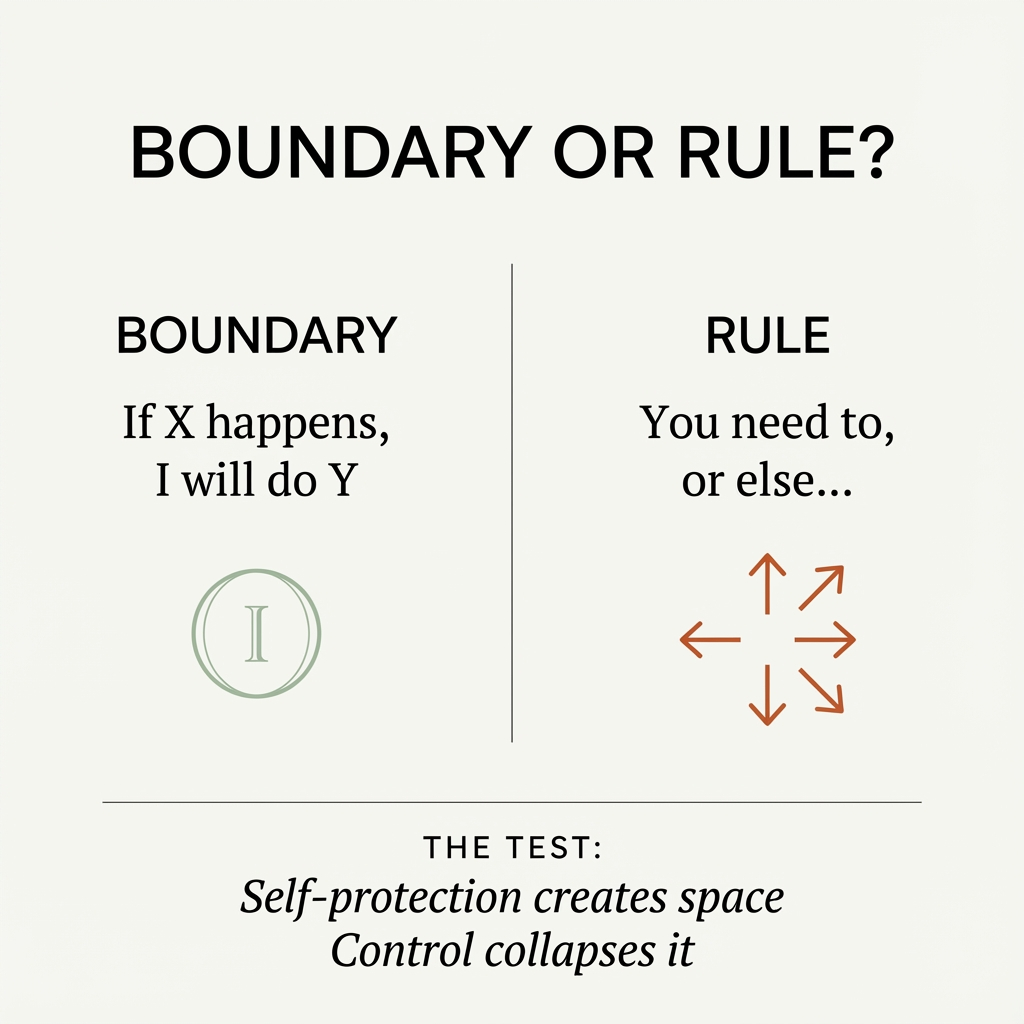
A boundary is self-referenced.
A rule is other-referenced.
That’s the core distinction.
When you’re truly setting a boundary, your language centers on your behavior, your limits, and your consequences. When you’re disguising control as a boundary, your language shifts responsibility onto the other person.
What a Real Boundary Sounds Like
A genuine boundary follows this structure: “If X happens, I will do Y.”
Examples:
-
“If I’m spoken to disrespectfully, I’ll end the conversation.”
-
“If plans are changed last minute, I won’t be able to attend.”
-
“I’m not available for conversations where I’m being yelled at.”
Notice what’s missing: no instructions, no policing, no demand that you change, no threat disguised as morality.
They’re simply stating what they will do to protect themselves.
What a Disguised Rule Sounds Like
A control-based “boundary” follows this structure: “You need to / You can’t / You have to, or else…”
Examples:
-
“My boundary is that you can’t talk to other people about this.”
-
“I’m setting a boundary that you need to respond faster.”
-
“My boundary is that you stop doing that.”
-
“If you cared about my boundary, you wouldn’t…”
This is not a boundary. It’s a behavioral mandate.
The giveaway is that their emotional regulation depends on your compliance.
The Mic-Drop Test
Here’s the cleanest way to spot it instantly.
Ask yourself: “If I don’t comply, are they describing what they will do, or punishing me for not obeying?”
-
If they adjust their behavior, it’s a boundary.
-
If they escalate, shame, withdraw, or threaten, it’s control.
Boundaries don’t require enforcement. Rules do.
What They’re Actually Protecting When They Enforce
When someone “enforces” a so-called boundary through escalation, shaming, or punishment, they’re not protecting themselves.
They’re protecting an internal structure.
Their Identity Narrative
They’re protecting the story they need to believe about themselves: I’m reasonable. I’m the victim. I’m the emotionally evolved one.
If you don’t comply, that identity cracks.
Enforcement becomes an attempt to stabilize the story, not the nervous system.
Their Sense of Control Over Emotional Safety
They don’t experience safety as something they generate internally.
Safety, to them, is predictability from others. Compliance. External regulation.
When you don’t comply, their system reads it as danger. Punishment becomes a way to re-establish control.
It’s not protection. It’s containment of their anxiety.
Avoidance of Internal Work
A real boundary requires tolerating discomfort, letting go of outcomes, accepting that others have autonomy.
That’s hard.
Rules avoid that work entirely. If they can make you responsible for their comfort, they never have to sit with insecurity, jealousy, fear of abandonment, or powerlessness.
Enforcement is avoidance with a moral label.
Their Role in the Dynamic
They’re protecting the role you play for them: the regulator, the validator, the mirror that confirms their worth, the stabilizer of their emotions.
If you step out of that role, enforcement pulls you back in.
The punishment isn’t about the behavior. It’s about restoring the function you serve.
Self-protection creates space. Control collapses space.
The Codependency Mirror You Don’t Want to See
Here’s the uncomfortable truth.
Someone who survives narcissistic abuse doesn’t automatically heal the function they were trained to perform. They often just change the language around it.
The behavior looks different. The vocabulary sounds healthier. But the role is the same.
Survival Skills Get Rebranded, Not Released
In narcissistic dynamics, you learn early and deeply: My safety depends on managing someone else’s emotional state.
That creates a role: regulator, stabilizer, emotional translator, peacekeeper.
When you leave the abusive dynamic, that role doesn’t disappear. It goes underground.
Instead of appeasing, people-pleasing, walking on eggshells, it morphs into “healthy communication,” “boundaries,” “emotional standards,” “trauma-informed language.”
Same nervous system job. New dictionary.
Why the Role Gets Recreated
Control felt like safety back then.
If you could anticipate moods, soothe reactions, prevent explosions, manage outcomes, you stayed safer.
Your nervous system learned: Regulation equals control.
So later, when someone doesn’t behave predictably, your body doesn’t think “This is uncomfortable.” It thinks “This is dangerous.”
The old skillset activates automatically.
Healing without detaching the role.
Many survivors do cognitive healing first: therapy language, insight, awareness, concepts. But the somatic attachment wiring is still intact.
So instead of saying “I need you to calm down or else,” it becomes “I’m setting a boundary around this energy.”
The behavior hasn’t changed. Only the justification has.
Identity whiplash.
After narcissistic abuse, there’s often a swing from silenced, minimized, controlled to hyper-sovereign, hyper-defensive, hyper-protective.
Boundaries stop being self-containment and start becoming territorial control.
Why? Because power feels like safety after powerlessness.
The Brutally Honest Truth
Most people who leave narcissistic abuse are not healed of relational control.
They’re healed of being controlled.
Those are not the same thing.
Without deep integration work, you can unconsciously become emotionally rigid, outcome-attached, regulation-dependent, intolerant of autonomy.
Just like the dynamic you escaped. Different flavor. Same mechanism.
Healing happens when you can say: “I can be dysregulated and still let you be autonomous.”
What the Shift Actually Looks Like
This is where theory either becomes lived or stays cosmetic.
Someone you care about does something that triggers you. They don’t respond how you hoped. They set a limit. They disagree.
Your body reacts first. Chest tightens. Heat in the face. A surge of urgency.
This isn’t okay. I need to fix this.
Old reflex: reach out, correct, clarify, explain, enforce, reframe it as a boundary.
The Fork in the Road
There is a 2–5 second window right here. Not long. But it exists.
The question is not “What should I say?”
It’s: “Am I trying to regulate myself or regulate them?”
That question alone interrupts the loop.
Step 1: Name the Truth Internally
Not “I’m setting a boundary.”
But: “I am dysregulated right now and I want relief.”
That honesty matters. No self-shaming. No spiritual bypass. Just truth.
Step 2: Allow the Sensation Without Action
This is the hardest part.
Instead of sending the message, enforcing the boundary, withdrawing to punish, explaining yourself into safety—you pause.
You let the sensation exist without resolution.
You might say internally: “This feels unbearable, but it is not dangerous.”
Your nervous system hates this. That’s the point.
Step 3: Separate Discomfort from Threat
Here’s the reframe that changes everything:
“I feel unsafe because I’m attached to an outcome, not because something bad is happening.”
That sentence dissolves entitlement to compliance.
You stop telling yourself “They’re being unfair” or “They’re violating me” and start telling the truth: “I don’t like this, and I don’t get to control it.”
Step 4: Choose Containment Over Control
Instead of doing something to them, you do something for yourself.
You put the phone down. You step outside. You breathe slower than your urge. You move your body. You sit with the urge without discharging it.
This is not repression. This is capacity building.
You’re teaching your system: “I can survive not being soothed.”
Step 5: Let the Outcome Be Uncertain
This is where the old self would enforce.
The healed self says: “I don’t know how this will turn out. And I’m staying present anyway.”
No chasing. No punishing. No moralizing. Just tolerance.
Healing is not calm. Healing is staying when you want to control.
What Makes the Pause Possible
The pause is not a personality trait. It’s a capacity.
Most people don’t lack insight. They lack nervous system bandwidth.
Their Nervous System Has Learned That Discomfort Is Survivable
For people who can pause, their body has already learned this truth: “Nothing terrible happens if I don’t act immediately.”
That learning didn’t come from insight. It came from repeated, embodied experiences of staying in discomfort and surviving it.
Without that history, your system fires: Act now or die.
They’ve Lost Faith in Urgency
People who can pause no longer believe urgency equals truth, intensity equals importance, or discomfort equals danger.
They’ve been wrong too many times.
Their system has learned: “Every time I rush to fix this, I make it worse.”
They Don’t Need the Other Person to Regulate Them Anymore
People who can’t pause still depend on reassurance, agreement, responsiveness, compliance to settle their system.
People who can pause have internalized regulation enough that relief does not require someone else changing.
That removes the chase reflex.
They Can Feel Shame Without Collapsing
The pause often opens with shame: I’m wanting to control right now. This isn’t about them. I’m attached to an outcome.
People who can’t tolerate shame discharge it outward through blame, righteousness, moral language, enforcement.
People who can tolerate shame can stay still long enough to choose.
The pause lives on the far side of shame tolerance.
Where to Actually Start
If you realize you’ve been making rules and calling them boundaries, here’s the first structural change.
You stop using other people as your primary regulation strategy.
Not emotionally. Not morally. Not relationally. Practically.
End Outcome-Leverage
When people turn rules into “boundaries,” they’re attaching their sense of safety to a specific outcome: you responding a certain way, you agreeing, you staying emotionally close.
The rule exists to force the outcome.
The first structural change is to remove outcome leverage entirely.
Old architecture: “I’m not okay unless this goes the way I need.”
New architecture: “I am responsible for staying regulated regardless of the outcome.”
Stop Announcing Boundaries Mid-Activation
Most rule-based “boundaries” are declared while dysregulated.
That trains your system to believe: “I only feel safe if I externalize control.”
So structurally, you stop doing this. Instead, you take space without explanation. You delay communication. You do not define, clarify, or correct in the moment.
This feels unbearable at first. That’s withdrawal from enforcement.
Build a Personal Regulation Protocol
People who don’t enforce boundaries have ritualized self-regulation. Not affirmations. Not insight. Physical, repeatable actions.
For example:
-
Walk before responding
-
Cold water on wrists or face
-
Breath pacing longer than the urge
-
Movement until sensation shifts
-
Writing without sending
This becomes the new containment structure. The rule was doing this job before.
Replace “You Can’t” With “I Will”
Not just in language. In behavior.
Old structure: “You can’t talk to me like that.”
New structure: “If this continues, I will step away.”
And then you actually do. No explanation. No punishment. No moral charge.
This retrains your nervous system to trust self-execution, not compliance.
Allow the Relationship to React Without You Managing It
When you stop enforcing, some people escalate. Some withdraw. Some reveal dependence. Some stabilize.
You do nothing to correct their reaction.
Why? Because internal architecture requires this belief to land somatically: “I do not need to manage other people’s responses to be safe.”
“I don’t need this to go my way to stay with myself.”
What Happens to Relationships
When you stop enforcing and start removing yourself, relationships don’t fail randomly. They sort.
What Breaks
Relationships built on regulation roles.
These are relationships where you were unconsciously assigned a job: emotional stabilizer, conflict diffuser, meaning translator, reassurer.
When you stop enforcing and simply remove yourself, the other person feels uncontained. Their response often looks like escalation, moralizing, panic, rage.
What’s breaking here is not intimacy. It’s dependence.
Bonds sustained by fear of rupture.
Some relationships only felt close because someone was always preventing collapse. When you stop doing that, silence stretches, awkwardness appears, distance grows. And no one repairs it.
Not because repair is impossible, but because repair was never mutual.
Dynamics where compliance was confused for love.
If your “yes” was how safety was maintained, your neutral absence will feel like rejection. These connections often end with accusations of coldness, rewriting of your intentions, character attacks.
That’s not about you leaving. It’s about the system losing control.
What Survives
Relationships with internal regulation on both sides.
In healthy relationships, when you remove yourself instead of enforcing, the other person pauses too. They self-reflect. They don’t chase, punish, or escalate. They respect the space without resentment.
There may be discomfort, but not chaos. These relationships often deepen after the shift.
Bonds that can tolerate uncertainty.
Some relationships survive because they were never built on predictability. They were built on choice, goodwill, curiosity, flexibility.
When enforcement stops, these people don’t interpret it as abandonment. They interpret it as: “They’re taking care of themselves.”
How You Tell the Difference
When you stop enforcing and start removing yourself, watch what fills the space.
If the space fills with curiosity, self-reflection, respect, patience: The relationship is viable.
If the space fills with blame, panic, punishment, narrative control, character attacks: The relationship was dependent, not relational.
No amount of enforcement would have made it healthy.
The Lonely Middle Phase
You will feel lonelier at first, even in healthier relationships.
Why? Because predictability creates a false sense of closeness. Autonomy creates real distance. That distance is what allows choice to return.
But here’s the question: How do you know you’re building architecture and not just becoming avoidant or emotionally detached?
The Core Distinction
Avoidance uses distance to escape feeling.
Architecture uses distance to stay with feeling without outsourcing it.
Same behavior. Opposite function.
The diagnostic isn’t “Am I stepping back?” It’s “What am I doing with myself while I’m back here?”
What Avoidance Feels Like Internally
Avoidance feels like relief first. There’s a shutting down. A flattening. A sense of “I don’t care anymore.”
Common markers:
-
Emotional numbness or fog
-
Justification narratives: “I don’t need anyone”
-
A subtle superiority or detachment stance
-
Rapid replacement behaviors: distractions, new attachments, busyness
-
No grief, just dismissal
Avoidance distances from vulnerability. It creates safety by shrinking contact with feeling itself.
What Architecture-Building Feels Like Internally
Architecture feels worse before it feels better. There is no numbness. There is exposure.
Common markers:
-
Loneliness that’s sharp, not hollow
-
Grief without a clear target
-
The urge to reach out, explain, fix, enforce
-
Anxiety without immediate discharge
-
A constant pull to abandon the process
You are not detached. You are present without relief.
Architecture distances from control, not from connection. That’s why it hurts.
The Most Reliable Test
Ask yourself honestly:
“Am I unavailable to avoid discomfort, or am I available to my discomfort without making it someone else’s job?”
Avoidant distance says: “I don’t want to feel this.”
Architectural distance says: “I am feeling this, and I’m staying.”
One collapses feeling. The other metabolizes it.
What Happens to Desire Is the Tell
In avoidance: Desire goes offline. People become interchangeable. Connection feels optional or burdensome.
In architecture: Desire remains, but you don’t chase it. You miss people without pursuing them. You feel longing without turning it into action.
Avoidance kills longing. Architecture contains it.
The Relationship Signal
If someone reached out respectfully tomorrow, would your system tense and want to disappear, or feel activated but open?
Avoidance forecloses possibility. Architecture leaves the door unlocked without standing in the doorway.
If distance makes you smaller, it’s avoidance. If distance makes you sturdier, it’s architecture.
The Final Truth
A boundary says: “This is what I will do to care for myself.”
A rule says: “This is what you must do so I don’t have to.”
Once you hear that shift, you can’t unhear it.
Enforcement preserves relationships by force. Removal preserves self-respect.
The relationships that survive self-respect were always real. The ones that don’t were only stable because someone kept holding the structure up.
Letting them fall is not abandonment. It’s gravity doing its job.
The lonely middle is not where you disappear. It’s where your internal load-bearing walls get built.
And yes, it’s supposed to feel quiet, exposed, and unspectacular.
That’s how you know it’s real.
Discover more from Healing but Dealing
Subscribe to get the latest posts sent to your email.
