
;When someone tells me they’re ready for a real relationship but their dating history reads like a catalog of emotionally unavailable partners, they’re not describing readiness.
They’re describing a familiar nervous system.
What they’re unknowingly revealing: They equate intensity with connection. They’re more practiced at chasing than choosing. They feel chemistry most strongly where safety is absent.
This isn’t a character flaw. It’s conditioning.
Readiness Is a Behavioral Pattern, Not a Declaration
If you were truly ready for a healthy relationship, your dating history would include people who were available, consistent, and capable of repair, even if those relationships didn’t work out.
Instead, what I usually see is someone who says they want intimacy but keeps selecting partners who make intimacy impossible.
That’s not bad luck. That’s alignment with an unhealed attachment wound.
What you’re really saying: “I want connection, but my nervous system only recognizes love when it feels like uncertainty, distance, or emotional work.”
You pursue emotionally unavailable partners not because you want chaos, but because calm feels foreign. Safety doesn’t register as chemistry yet.
What Happens When You Sit Across From Someone Available
When your nervous system is calibrated to uncertainty and you sit across from a genuinely available person, nothing is wrong with them.
What’s happening is an internal mismatch.
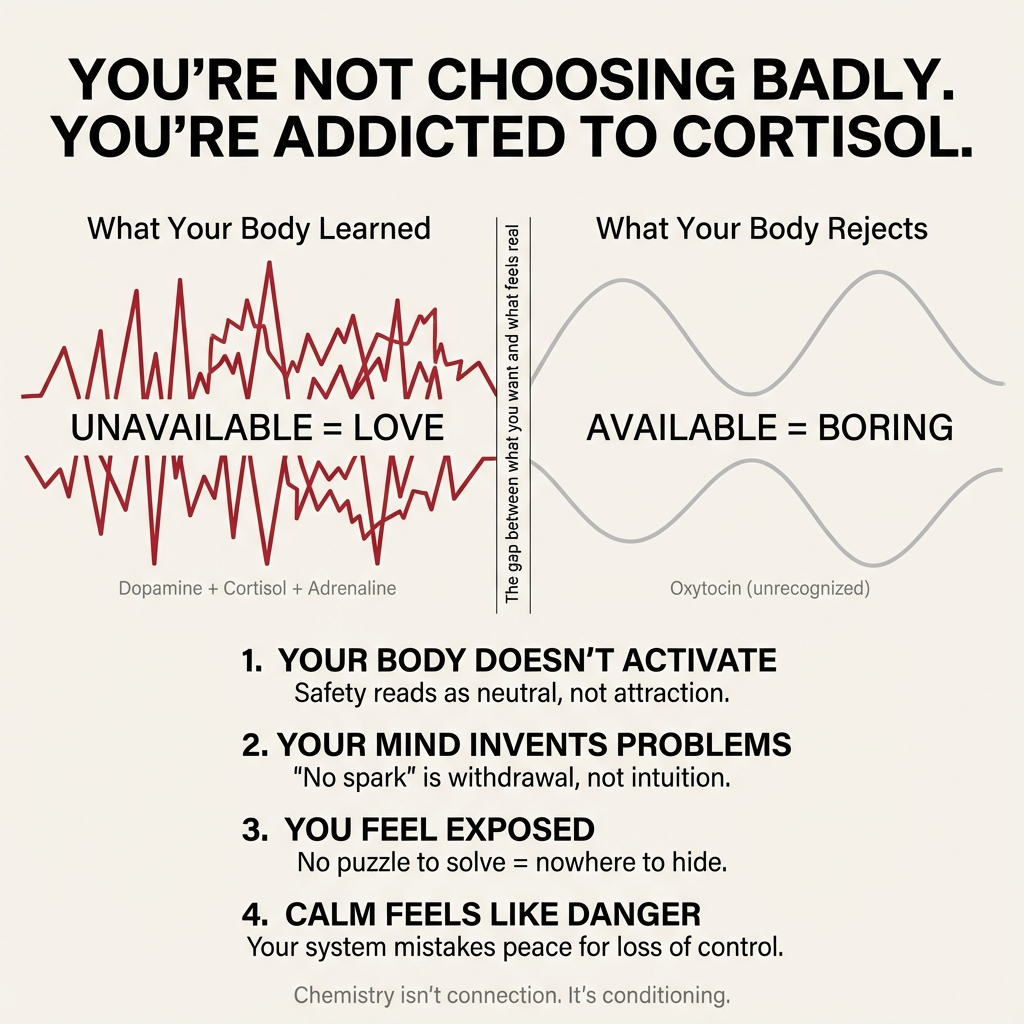
First, your body doesn’t activate. There’s no spike. No charge. No adrenaline. No hyperfocus. The nervous system that learned love through inconsistency expects tension as proof of importance. Availability doesn’t create tension, so your body reads it as neutral. Neutral gets mislabeled as boredom.
Second, your mind goes searching for a problem. Because your body isn’t lit up, your brain fills in the gap. Thoughts start surfacing like “I don’t feel a spark” or “Something’s missing” or “They’re nice, but…” or “They’re great on paper, but I’m not excited.”
That’s not intuition. That’s withdrawal from a stimulus your nervous system is addicted to.
Third, there’s a subtle sense of exposure. With an emotionally available person, there’s nowhere to perform, chase, prove, or earn. No emotional puzzle to solve. No distance to close. When someone sees you clearly and is still present, your nervous system doesn’t feel rewarded. It feels unmasked.
Fourth, your body interprets safety as loss of control. In chaotic dynamics, control comes from hypervigilance. You’re scanning, adjusting, earning. With availability, that role disappears. Your nervous system mistakes the absence of vigilance for danger.
So instead of leaning in, you disengage. You intellectualize. You stall. You friend-zone. You say “I just don’t feel it.”
What you’re actually feeling is detox.
The Addiction Loop You’re Stuck In
You’re experiencing the absence of cortisol and dopamine loops you’ve associated with love. Your system hasn’t learned yet how to register oxytocin as attraction.
Here’s the part that matters most. If you leave that situation, you’ll likely feel a sudden rush of longing later. Not because the person was wrong, but because distance reactivates the familiar signal. The moment safety is gone, desire returns.
That’s the addiction loop.
This is why you swear you “lost feelings” for healthy partners and then feel obsessed with unavailable ones. You didn’t lose feelings. You lost stimulation.
Until you retrain your nervous system, availability will feel underwhelming and unavailability will feel magnetic. Not because that’s love, but because that’s what your body learned to survive.
That’s the difference between chemistry and conditioning.
The Structural Rewiring Process
Awareness is diagnostic, not corrective. You keep mistaking insight for intervention. The pattern doesn’t break because it’s not a belief problem. It’s a conditioning problem.
Conditioning only changes through structure, not willpower.
The dopamine-cortisol loop has to be interrupted long enough for withdrawal to complete. Unavailability creates a biochemical cocktail. Dopamine from anticipation, cortisol from uncertainty, intermittent reinforcement from inconsistent reward. The loop doesn’t dissolve because you understand it. It dissolves when you stop feeding it.
Structurally, this means prolonged disengagement from activating dynamics. Not dating better people on the side. Not keeping emotionally unavailable exes in orbit. Not rehashing old connections for emotional hits.
Your nervous system needs sustained absence of the stimulus to downregulate its baseline.
Until withdrawal completes, availability will always feel flat because your system is still calibrated to a higher intensity threshold.
Your body has to learn safety through repetition, not logic. Safety doesn’t register as pleasure at first. It registers as neutrality. Sometimes even discomfort. The work isn’t to “feel chemistry.” You need to stay present long enough for your body to update its map.
That means tolerating the urge to self-sabotage when nothing is wrong. Sitting through dates that don’t spike adrenaline. Letting consistency feel boring without labeling it wrong.
Repeated exposure to non-activating connection teaches your nervous system that calm does not equal danger or loss.
The Grief Nobody Talks About
You have to grieve intensity as identity.
For many people, intensity wasn’t stimulation alone. It was identity. “I’m passionate.” “I feel deeply.” “I love hard.”
What you’re grieving is the loss of a role where suffering equaled meaning. When availability enters, the identity collapses. There’s no dramatic arc. No emotional heroism. No highs and lows to narrate.
Until you grieve the loss of that identity, you’ll keep reaching for dynamics that let you feel alive through struggle. Availability will feel flat because it doesn’t confirm who you think you are.
This grief isn’t sentimental. It’s existential.
When the Calm Arrives and You Want to Sabotage It
When the urgency softens around day four or five of no contact, you don’t feel triumphant. You feel emptied out. The adrenaline is gone. The obsession quiets. The charge drops.
Instead of interpreting this as regulation, you interpret it as loss of self.
The most common justification: “I guess this means I never cared.”
That thought is lethal.
What you’re experiencing is the absence of dysregulation, but your mind translates the absence as emotional death. If intensity has been your proof of attachment, calm feels like indifference. You panic and try to resurrect feeling, not connection.
The second justification is more seductive. “I’m in a healthier place now. I handle it differently.”
This is the relapse fantasy.
You mistake nervous system regulation for resilience. You assume that because the urge has softened, you’re now strong enough to re-enter the dynamic without getting hooked. You don’t realize the stimulus hasn’t changed, only your distance from it.
You test yourself. One text. One check-in. Closure.
The moment you re-engage, the loop snaps back online. Dopamine floods. Cortisol spikes. Your body lights up. You say, “See? There it is. That’s how I know it’s real.”
What you don’t see: you reintroduced the drug and mistook the hit for love.
How to Tell the Difference Between Rewiring and Forcing It
Someone reaches that point where they finally feel present instead of pursuing. Then a genuinely available person shows up.
You can force availability just as hard as you once chased distance.
I don’t tell people, “If it’s calm, it’s right.” That’s lazy and dangerous. I teach them how to tell the difference in the body over time, not in a single date or feeling state.
Calm versus collapse: When your body isn’t used to availability, you feel neutral but present. You’re curious. You can stay in the interaction without checking out. Your breath is steady. You might think, “I don’t feel swept away, but I feel like myself.”
When someone is wrong for you, your body doesn’t just feel calm. It feels collapsed. There’s a subtle constriction. You’re polite but not engaged. Time drags. You feel smaller, dulled, or slightly irritated.
Ask yourself this. “Do I feel more like myself with them, or less?” Not more excited. More yourself.
Curiosity grows or curiosity dies: With a healthy, available person during rewiring, attraction is often delayed but expanding. You find yourself wanting to know them more. You replay moments not with obsession, but with warmth.
With someone you’re forcing, curiosity flatlines. There’s no internal movement. You’re not wondering about them. You’re evaluating them.
Healthy attraction grows. Forced attraction stagnates.
Your nervous system response after contact: After spending time with a genuinely healthy match during rewiring, you feel regulated afterward. Not euphoric, but settled. There’s no crash. No rumination. No self-critique.
After time with someone who’s wrong, even if they’re available, there’s often low-grade agitation or depletion. A sense of effort. Subtle resentment.
Stop asking, “How did I feel with them?” Start asking, “How did I feel after?”
Your body tells the truth there.
The Truth You Don’t Want to Hear
You don’t become ready for a healthy relationship by wanting one badly enough.
You become ready when you can tolerate consistency without trying to earn it. When you stop mistaking potential for partnership. When you can walk away from someone who activates you instead of choosing them because they do.
Until then, “I’m ready” is often just another way of saying, “I’m tired of being hurt, but I haven’t changed the pattern that keeps hurting me.”
The shift isn’t “I choose availability no matter what.”
The shift is “I trust my body again, now that it’s no longer addicted to chaos.”
That’s when going back stops feeling tempting and starts feeling expensive.
Discover more from Healing from Narcissistic Abuse, Toxic Relationships & Codependency | Christina Stuller
Subscribe to get the latest posts sent to your email.
