
I need to say something that’s going to make some people uncomfortable.
The healing culture we’ve built is gaslighting survivors.
You’ve heard it before. Someone shares their experience with narcissistic abuse, the aftermath of complex trauma, the weight they still carry from years of emotional manipulation. And within minutes, someone responds with the same tired advice: “You just need to let it go.”
As if healing were a light switch. As if trauma were a choice you’re making every morning when you wake up.
This isn’t support. This is spiritual bypassing dressed up as wisdom.
I’ve watched this pattern destroy people who were already fighting to survive. The pressure to “move on” becomes another form of abuse, another voice telling survivors their reality doesn’t matter, their pain isn’t valid, their timeline is wrong.
Research confirms what survivors already know: toxic positivity functions as gaslighting. It exacerbates symptoms of PTSD, depression, and anxiety. It creates isolation and shame that makes it harder for survivors to seek help.
When you tell someone to “just let it go,” you’re not offering healing. You’re offering erasure.
The Problem With Quick-Fix Healing
Our culture is obsessed with resilience porn.
We want the tidy narrative arc. The transformation montage. The before-and-after that proves healing is possible if you just try hard enough, think positive enough, release enough.
But trauma doesn’t work that way.
Healing from narcissistic abuse takes months or years, depending on the depth of the relationship and the support system in place. Recovery isn’t linear. Setbacks don’t mean you’re failing. They’re part of the process.
The pressure to “bounce back” reflects our collective discomfort with intense emotions. We want quick fixes and easy answers because sitting with someone’s pain makes us uncomfortable.
So we rush to solutions. We offer platitudes. We suggest letting go before the person has even been allowed to hold on.
This isn’t compassion. This is avoidance.
People are largely so uncomfortable with holding space for survivors that they rush to the solution stage to make the discomfort go away. But that’s not what survivors need. One of the biggest contributors to moving unconsciously toward relationships that feel familiar but unsafe is not being truly seen and heard.
When “Letting Go” Mirrors the Original Trauma
Here’s what most people don’t understand about toxic positivity and trauma survivors.
For survivors of narcissistic abuse, being pressured to be positive can mirror aspects of their original trauma. Especially if their traumatic experiences involved having their emotions dismissed or being forced to suppress their true feelings.
You’re asking someone who spent years being told their reality didn’t matter to now dismiss their own experience.
You’re asking someone who learned to silence their needs for survival to silence themselves again. For your comfort this time.
This runs counter to every principle of trauma-informed care. Trauma-informed approaches emphasize validation, safety, and empowerment. They create space for the survivor’s experience without rushing to fix, solve, or transcend.
When you tell a survivor to let go, you’re repeating the same pattern that caused the wound in the first place.
The narcissist told them their feelings were wrong, too dramatic, too sensitive. The narcissist insisted they move on from the hurt they caused. The narcissist demanded forgiveness without accountability.
Sound familiar?
The Neuroscience of Why You Can’t Just Let Go
For those who experienced complex trauma—repeated childhood neglect, emotional abandonment, or abuse—the past isn’t just history.
It’s a survival manual your nervous system still follows religiously.
Your body learned to read danger in specific tones of voice, facial expressions, silences. These patterns got encoded as protection. Your nervous system built an entire threat-detection system based on what kept you safe when you were powerless.
Letting go isn’t about willpower. It’s about updating your survival manual with new, more accurate information.
This takes time. It requires safety. It demands validation of what was real.
When you experienced years of being told you’re wrong or incapable, your judgment gets compromised. Many survivors describe feeling as if they lost their sense of identity. Making decisions becomes difficult because you learned not to trust yourself.
You can’t think your way out of what your body learned for survival.
What Suppressing Emotions Actually Does
The “let it go” crowd believes they’re helping you avoid getting stuck in your pain.
What they’re actually doing is teaching you to bypass, blunt, stuff, deny, and numb.
Constantly suppressing emotions results in both mental and physical illness. When we deny ourselves access to authentic emotional experiences, the cracks eventually show. Our feelings manifest in distressing and confusing ways: anxiety, depression, dissociation.
The energy of suppressed emotions doesn’t disappear. It remains deep inside your consciousness, preventing actual healing.
You can’t heal what you’re not allowed to feel.
Research shows that when people invalidate our negative emotions, we start to believe our emotions are wrong. And because we can’t just change how we feel, toxic positivity becomes unsustainable. The pressure builds. The disconnection deepens.
Eventually, something breaks.
The Difference Between Validation and Wallowing
I know what some of you are thinking.
“But Christina, aren’t you just encouraging people to stay stuck in victim mentality?”
No. I’m encouraging people to stop pretending their trauma didn’t happen so other people feel more comfortable.
There’s a difference between validation and wallowing. There’s a difference between processing and performing. There’s a difference between healing and hiding.
Validation says: what happened to you was real. Your response makes sense. You’re not broken for still carrying this.
Wallowing says: this defines you forever. You have no agency. Your past determines your future.
I teach people to build boundaries, recognize patterns, and develop functional autonomy. But none of that happens by skipping over the part where we acknowledge what was true.
You don’t build a foundation by pretending the ground isn’t damaged.
Most people naturally recover from trauma symptoms over time. Their reactions lessen. But it can take days, weeks, or months. Ignoring or avoiding symptoms isn’t a healthy coping response. In fact, avoiding them makes things worse.
What Survivors Actually Need
Survivors don’t need you to fix them.
They need you to believe them. To sit with them. To stop rushing them through their own experience because it makes you uncomfortable.
They need space to name what happened without being told it wasn’t that bad, they’re being too sensitive, or they should have left sooner.
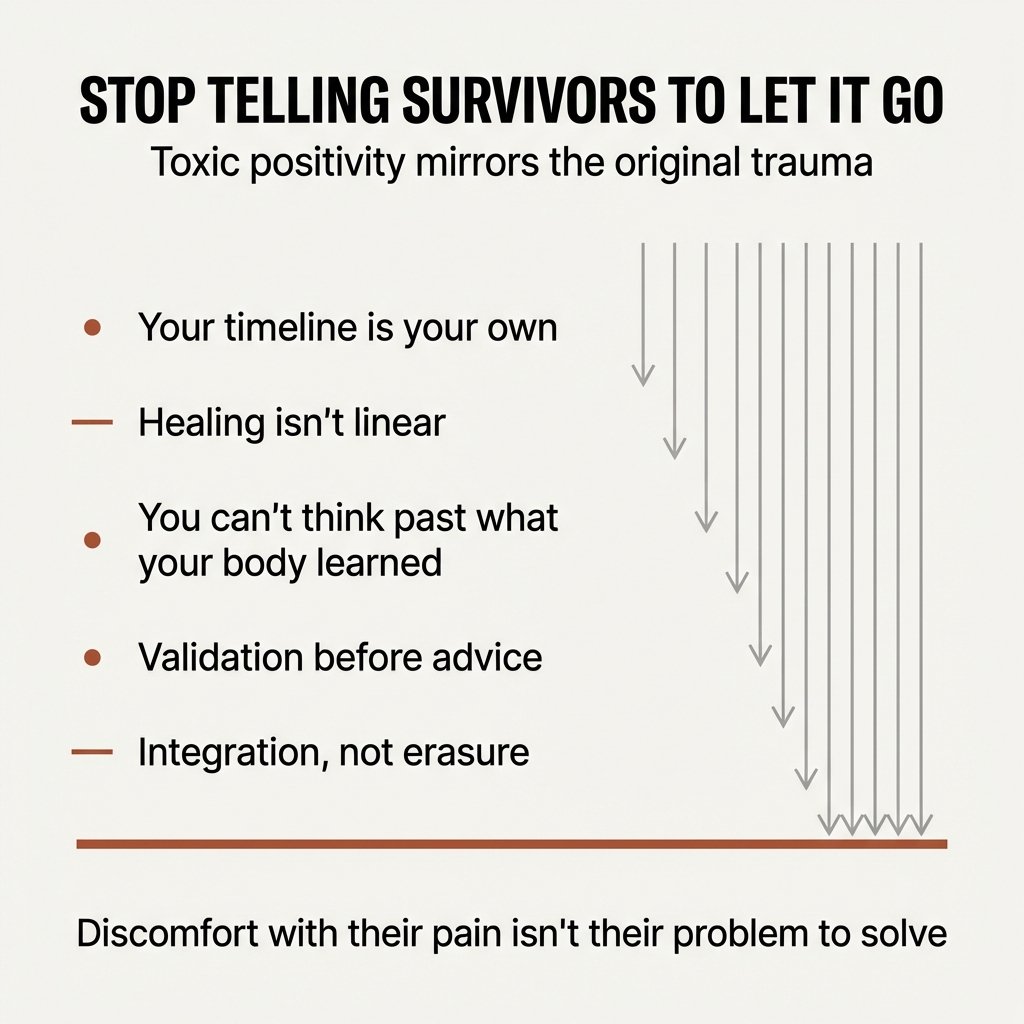
They need validation that their timeline is their own. That healing doesn’t follow a schedule. That setbacks don’t mean failure.
They need you to stop treating their pain like a problem you need to solve.
The most powerful thing you can offer someone in pain is presence without agenda. Listening without fixing. Witnessing without judgment.
This is uncomfortable. It requires you to sit with emotions you can’t resolve. It asks you to tolerate uncertainty and messiness.
But discomfort is not the same as harm. Your discomfort with someone’s pain is not more important than their need to process it.
Building a Different Kind of Healing Culture
We need a healing culture that makes space for the full spectrum of human experience.
One that doesn’t rush survivors through their grief to get to the inspirational part. One that doesn’t treat emotional honesty as negativity. One that understands the difference between hope and toxic positivity.
Real healing culture looks like this:
It validates before it advises. It asks what someone needs instead of assuming what they should do.
It recognizes that healing is non-linear. Progress includes setbacks, confusion, and days when you feel like you’re back at the beginning.
It makes room for anger. Survivors have a right to their rage. It’s information. It’s protection. It’s often the first sign that someone is starting to recognize what was done to them.
It doesn’t confuse boundaries with bitterness. Cutting off contact with an abuser isn’t holding a grudge. It’s self-preservation.
It stops treating forgiveness as a requirement. You don’t owe your abuser peace. You owe yourself safety.
It understands that some things can’t be let go—they have to be integrated. The goal isn’t to forget what happened. It’s to build a life where what happened no longer controls you.
What I Tell My Clients
When someone comes to me drowning in shame because they can’t seem to “just move on,” I don’t soften it.
I tell them the truth.
You’re not failing at healing. You’re succeeding at survival. Your nervous system is doing exactly what it was trained to do when staying alert to danger kept you alive.
The problem isn’t you. It’s that everyone around you is treating your protection mechanism like a personality defect.
You’re not stuck because you’re weak. You’re stuck because you’re trying to recover in the same environment that taught you to doubt your own reality.
Stop trying to let go. Start recognizing that your body remembers what your mind was forced to forget.
The work isn’t about releasing the past. It’s about learning to distinguish between actual threat and the echo of old danger. It’s about updating a survival system that’s still running on outdated code.
You don’t heal by pretending it didn’t happen. You heal by building a life where what happened no longer determines what happens next.
The past doesn’t need to be erased. It needs to stop being in charge.
The Bottom Line
Stop telling trauma survivors to let it go.
Start asking what they need. Start believing them when they tell you. Start sitting with the discomfort of not having a quick fix to offer.
Your discomfort with their pain is not their problem to solve.
Healing happens when we stop rushing people through their own experience and start creating space for them to move at their own pace. When we stop treating emotional honesty as negativity and start recognizing it as courage.
The survivors I work with don’t need rescue. They need recognition. They need permission to take as long as it takes. They need someone to stop telling them their timeline is wrong.
They need a healing culture that doesn’t gaslight them in the name of growth.
That’s what I’m building. That’s what we all should be building.
Because the people who survived the unsurvivable deserve better than being told to just get over it.
If you’re done waiting for permission to trust your own reality, book a one-on-one session. Let’s build the clarity you’ve been looking for.
Discover more from Healing but Dealing
Subscribe to get the latest posts sent to your email.
