
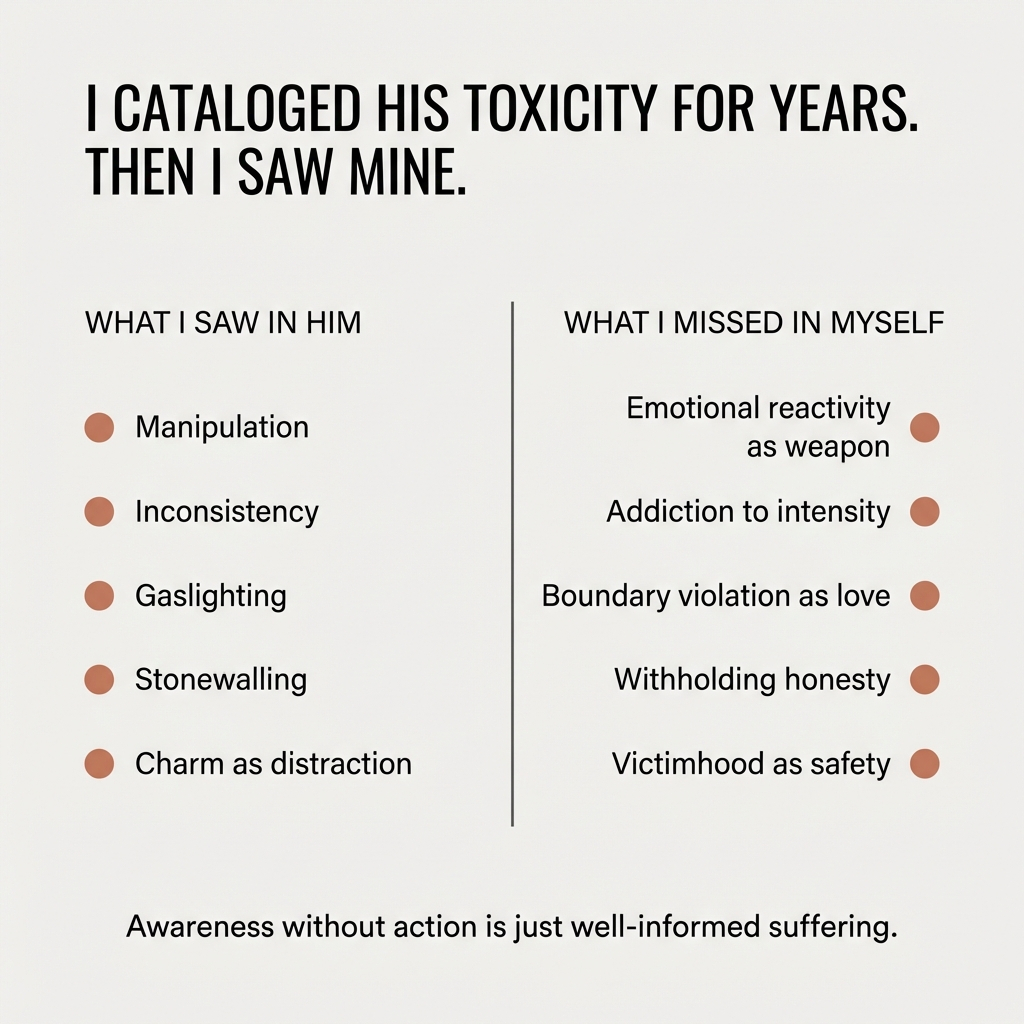
I spent years cataloging his toxicity.
Every manipulation. Every lie. Every time he twisted my words until I questioned my own memory.
I kept a mental inventory of all the ways he was the problem.
Then he betrayed me in a way I couldn’t rationalize.
In the wreckage of that moment, I saw something I’d been avoiding for years.
I saw myself.
The toxic behaviors I’d been tracking in him? I recognized the signature.
I’d been running some of the same patterns, just with different packaging.
The Mirror You Don’t Want to Look Into
Betrayal has a specific function in toxic relationships.
It strips away the performance. The justifications collapse.
The story you’ve been telling yourself about who you are and who they are suddenly doesn’t hold.
I’d convinced myself I was the aware one. The one doing the work. The one who could see through his games.
But awareness without accountability is just sophisticated denial.
I was tracking his toxicity while ignoring my own.
I was so focused on his manipulations that I missed how I’d been manipulating the narrative to keep myself in the victim position.
Victimhood felt safer than ownership.
If I was just the person being hurt, I didn’t have to look at the ways I was participating in the dysfunction.
I didn’t have to admit that staying was a choice.
Tolerating his behavior was teaching him exactly how to treat me.
What I Learned From Being Toxic
Here’s what I had to face:
I’d been using emotional reactivity as a weapon.
When he’d pull away, I’d escalate. When he’d go cold, I’d create chaos to force connection.
I told myself I was just responding to his behavior, but I was training him to expect my instability.
I was addicted to the intensity.
The highs after the lows. The reconciliation after the blowup.
I said I wanted peace, but I kept choosing the person who guaranteed drama.
Drama felt like passion, and passion felt like proof that it mattered.
I’d been boundary-violating in the name of love.
Reading his messages. Showing up unannounced. Demanding access to his phone, his time, his attention.
I called it accountability, but it was control dressed up in concern.
I’d been punishing him for not healing fast enough.
For not changing on my timeline. For not becoming the person I needed him to be.
I said I accepted him, but my resentment told a different story.
I’d been withholding honesty to avoid conflict.
Saying “I’m fine” when I wasn’t. Pretending things didn’t bother me until they exploded.
Building resentment in silence and then detonating it without warning.
I blamed him for not reading my mind while refusing to speak clearly.
What I Learned From His Toxicity
Watching someone operate from a place of deep dysfunction teaches you things therapy never will.
Toxic people aren’t villains.
They’re operating systems running on corrupted code. Most of them don’t wake up planning to destroy you. They’re just executing the only relational program they know.
Charm is a distraction mechanism.
The more someone needs to convince you of their goodness, the less secure that goodness is.
People who are solid don’t need constant validation of their character.
Inconsistency is information.
When someone shows you twenty versions of themselves, none of them are the real one.
The real one is the pattern underneath all the performances.
Words without matching behavior are just noise.
“I love you” means nothing if the actions communicate indifference.
“I’ll change” means nothing if the pattern stays intact.
Triangulation is a core strategy.
Bringing other people into the relationship to validate his perspective. Using past relationships as weapons.
Keeping me off-balance by making me compete for a position I already held.
Stonewalling is violence in slow motion.
The silent treatment. The emotional withdrawal. The withholding of basic communication as punishment.
It’s designed to make you so desperate for reconnection that you’ll accept blame for things you didn’t do.
Gaslighting isn’t always intentional.
Sometimes people genuinely don’t remember things the way you do.
But when their version of reality consistently erases your experience, intention stops mattering.
The Lesson That Changed Everything
The hardest thing I had to accept: I wasn’t trapped. I was complicit.
Every time I stayed after a boundary violation, I was teaching him that my boundaries were negotiable.
Every time I accepted an apology without changed behavior, I was training him that words were enough.
Every time I made excuses for his dysfunction, I was participating in my own diminishment.
The betrayal forced me to stop outsourcing responsibility for my life.
I couldn’t keep blaming him for doing exactly what he’d always done while I kept choosing to stay.
Awareness without action is just well-informed suffering.
I knew he was toxic. I could describe every pattern. I could predict every move.
But knowing didn’t protect me.
I kept choosing familiarity over freedom.
What Happens When You Stop Performing Healing
Real change started when I stopped trying to heal him and started building boundaries that didn’t require his cooperation.
I stopped explaining myself. Stopped defending my reality. Stopped trying to make him see what he was doing.
People who want to understand you will ask questions. People who want to control you will demand explanations.
I stopped treating his potential like it was more real than his pattern.
I stopped investing in the person he could become and started responding to the person he was.
I stopped waiting for him to validate my experience.
I didn’t need him to admit what he did. I didn’t need him to apologize correctly.
I didn’t need closure from someone who’d spent years keeping me open.
I started treating my clarity as more valuable than his comfort.
And that’s when everything shifted.
The Truth About Toxic Relationships
They don’t break you. They reveal where you were already fractured.
The dysfunction you tolerate in others is usually the dysfunction you haven’t addressed in yourself.
The boundaries you can’t enforce externally are the ones you never built internally.
Toxic relationships are diagnostic.
They show you where your self-worth is compromised. Where your fear of abandonment outweighs your need for respect. Where your addiction to intensity overrides your desire for stability.
The betrayal that broke me open also gave me the clearest view I’d ever had of my own operating system.
I could finally see the patterns I’d been running. The ways I’d been choosing chaos. The reasons I kept ending up in the same type of relationship with different faces.
What I Know Now
Healing isn’t about becoming someone who never gets hurt.
It’s about becoming someone who doesn’t stay in situations that require you to shrink.
You don’t need to forgive people who haven’t earned it. You don’t need to keep doors open that should be locked.
You don’t need to be understanding about behavior that violates your basic dignity.
You need to stop negotiating with your own clarity.
When you know something is wrong, you don’t need more evidence. You don’t need to wait for it to get worse.
You don’t need permission to protect yourself.
The people who love you won’t make you feel insane for trusting your instincts.
They won’t require you to ignore your reality to maintain the relationship. They won’t punish you for having needs.
And if you find yourself in a relationship where your sanity is the price of admission?
That’s not love. That’s captivity with better marketing.
The Work That Actually Matters
I don’t regret the toxic relationship.
I regret how long I stayed once I knew better.
The work now is building a life where dysfunction doesn’t feel like home. Where peace doesn’t register as boredom. Where healthy communication doesn’t feel like something’s missing.
The work is learning to recognize red flags in real time instead of in retrospect.
To trust the first sign instead of waiting for the tenth. To value consistency over intensity.
The work is becoming someone who doesn’t need chaos to feel alive.
I didn’t just learn about his toxicity or my own.
I learned that staying unconscious is a choice. That awareness creates responsibility. That once you see the pattern, you can’t unsee it.
You have to decide if you’re going to keep running it, or if you’re finally ready to build something different.
The betrayal gave me that choice.
I’m still deciding every day to choose differently.
If you’re ready to start changing your patterns, schedule today at healingmyfeelings.com
Discover more from Healing from Narcissistic Abuse, Toxic Relationships & Codependency | Christina Stuller
Subscribe to get the latest posts sent to your email.
