
The argument replayed in my head for three days straight.
Not because I couldn’t let it go. Because I was trying to figure out if I was crazy.
My partner had twisted the conversation so many times by the end, I was apologizing for things I didn’t do, defending feelings I had every right to have, and questioning whether my version of events had happened at all.
That’s how bullying in a relationship works.
It doesn’t announce itself. Doesn’t show up with bruises you photograph or insults you record. Shows up as confusion. As constant second-guessing. As the slow erosion of your ability to trust what you know to be true.
And if you’ve already spent years learning to doubt yourself, if you grew up in spaces where your feelings were too much, your needs weren’t valid, and your safest bet was to second-guess yourself into oblivion, the bullying doesn’t stop at hurt.
It feels like confirmation.
The Collapse Happens Fast
I didn’t wake up one day and realize I was being bullied.
It was subtler than that.
Small comments felt off but not wrong enough to address. Jokes at my expense I was supposed to laugh at. Conversations where my concerns were dismissed as overreactions. Moments where I felt hurt, tried to explain why, and ended up being told I was too sensitive, too dramatic, too much.
Every boundary I tried to set was reframed as me being controlling.
Every time I named what I was feeling, I was told I was misremembering, exaggerating, or making things up.
Every instinct I had was questioned until I stopped trusting any of them.
I’d built a career on pattern recognition. On seeing what others missed, on calling out dysfunction before it formed. But in my own relationship, I couldn’t see what was happening to me.
When the person bullying you is the person you love, your brain does something devastating.
It protects them instead of you.
That’s the real damage of relational bullying.
They hurt you. Then they convinced you the hurt wasn’t real. Your perception was the problem. If you were less sensitive, less needy, less difficult, everything would be fine.
Betrayal Trauma Theory explains this whiplash. When the person who harms us is someone we rely on for love or stability, our brains hold contradictory truths. I love you, and you’re hurting me. The system shorts out.
When you’ve already been conditioned to override your own instincts, the short circuit doesn’t reset easily.
The Freeze Isn’t Weakness
I used to think my inability to leave was a character flaw.
Now I understand it was survival.
When your ability to trust yourself has been chipped away over months or years, whether through emotional neglect, relational trauma, or the constant drip of being told your reality isn’t real, your nervous system learns making a choice is dangerous.
So you freeze.
You give them one more chance. You try to explain yourself better. You wait for proof that you’re not imagining things.
The world reads the freeze as weakness, as lack of self-respect, as choosing to stay. What is it? Your system trying to protect you from making a decision confirming your worst fear. You’re unlovable, unreasonable, and wrong about everything.
Studies show 84% of betrayed individuals report anger more intense than anything they’ve felt before. Beneath the anger is something more destabilizing. The erosion of self-trust.
You stop trusting your read on the relationship. You stop trusting your feelings. You stop trusting that what you’re experiencing is bad enough to justify leaving.
In my world, where I teach others to recognize toxic patterns, to trust their instincts, to stop negotiating with their own clarity, the collapse felt unbearable.
How do you teach people to trust themselves when you can’t trust yourself?
Rebuilding Doesn’t Start Where You’d Expect
I wanted clarity.
I wanted one undeniable moment where my partner would reveal themselves so completely I’d have no choice but to leave. I wanted proof I could point to and say, See? I wasn’t making it up.
That moment never came.
Waiting for it kept me stuck.
Here’s what I had to learn the hard way. You don’t rebuild trust by waiting for the other person to validate your reality. You rebuild it by making micro-moves feeling both terrifying and necessary.
You don’t rebuild self-trust by thinking positive thoughts or waiting for the right feeling. You rebuild it through small, low-pressure decisions you follow through on, even when they feel wrong, even when you’re not sure, even when the other person is telling you you’re overreacting.
For me, that looked like:
Naming what I felt without apologizing for it. Even when my partner said I was being dramatic. Even when they made me feel like I was the problem.
Setting a boundary and holding it. Even when they sulked, punished me with silence, or told me I was being unfair.
Listening to the voice in my head that said “this isn’t okay.” Even when I couldn’t prove it. Even when everyone else thought we looked fine from the outside.
Each small decision was a data point. Not proof I was right. Proof I could trust my own perception and survive the fallout.
That’s the foundation.
The Difference Between Healing and Dealing
I’m not fully healed from that relationship.
I still have moments where I over-explain myself. Where I brace for conflict that isn’t coming. Where I apologize for having needs before anyone has a chance to tell me I’m asking for too much.
But I’m dealing.
Dealing means I don’t wait for the wound to close before I set boundaries. I don’t wait for certainty before I trust my instincts. I don’t wait for someone else to validate my feelings before I act on them.
Here’s what I know now I didn’t know then:
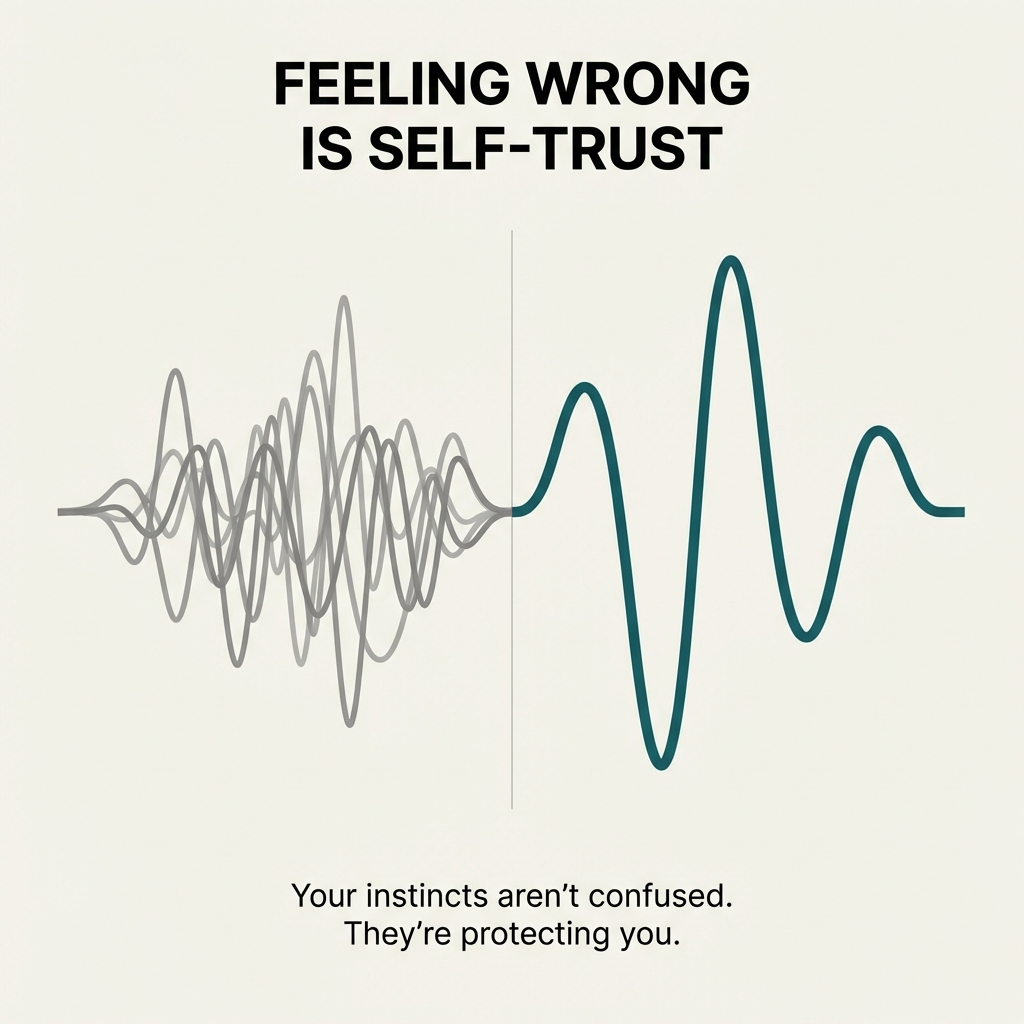
Feeling wrong is self-trust trying to protect you.
When you feel something is off, when your gut says this person isn’t safe, when your instincts scream get out, when your body tenses every time they walk into the room, you’re not confused.
That’s clarity.
You’re dialed into the reality of the situation. You’re reading the pattern beneath the performance. You’re seeing what they work hard to keep hidden.
If you’ve been conditioned to doubt the signal, if you’ve been told you’re too sensitive, too reactive, too much, you’ll dismiss it.
Dismissing it doesn’t make you safer. You’re slower to protect yourself when the situation escalates into something you no longer deny.
Trust Is Architecture, Not Negotiation
I used to think trust was something I had to earn back from my partner.
Now I understand it’s something I had to rebuild in myself.
You don’t argue for your boundaries. You install them and walk away from anyone who refuses to respect the walls.
You don’t wait for someone to validate your perception. You act on what you know and let their reaction tell you everything you need to know.
You don’t process endlessly hoping they’ll finally understand. You make a decision and let the outcome show you who they really are.
This isn’t cold. It’s structural.
The alternative, waiting for the person bullying you to admit they’re bullying you, keeps you trapped in a system designed to never give you confirmation.
I refuse to operate this way anymore.
What I’d Tell Someone Still in the Fog
If you’re reading this and you’re not sure if what you’re experiencing counts as bullying, if you keep making excuses for behavior that hurts you, if you can’t trust whether you’re overreacting or finally seeing clearly, here’s what I want you to know:
You don’t need proof to trust yourself. If it feels wrong, it is wrong. Your nervous system isn’t confused. It’s trying to protect you.
You’re questioning yourself. There’s your evidence. Healthy relationships don’t make you doubt your sanity. They don’t require you to constantly defend your reality.
You won’t get the closure you’re waiting for. They won’t suddenly see the harm they caused and apologize. Waiting for the moment keeps you stuck.
Start with small acts of self-trust. Say no without explaining. Stop apologizing for having feelings. Notice when you’re making yourself smaller to keep the peace.
Healing and dealing coexist. You don’t have to be fully recovered to start protecting yourself. You just have to be willing to take the next step while still carrying the confusion.
The Work Continues
I still think about that relationship sometimes.
Doesn’t define me anymore.
I’ve built something stronger than external validation. I’ve built a system where my perception matters more than someone else’s denial. Where my boundaries hold even when they’re inconvenient. Where my instincts guide me even when I don’t have proof they’re right.
That’s not confidence. That’s architecture.
It’s the only foundation worth building on.
If you’re in the wreckage right now, if someone’s manipulation has shattered your trust in yourself, I’m not going to tell you it gets easier.
But I will tell you this: you already know what’s true.
I’m just not letting you pretend otherwise.
Ready to rebuild trust in yourself and stop negotiating with your own clarity? Visit healingmyfeelings.com to start your journey toward emotional sovereignty.
Discover more from Healing from Narcissistic Abuse, Toxic Relationships & Codependency | Christina Stuller
Subscribe to get the latest posts sent to your email.
