
You already know what you’re doing.
That conversation you’ve been avoiding? The boundary you keep renegotiating? The story you tell yourself about why you haven’t spoken up yet?
You know the truth.
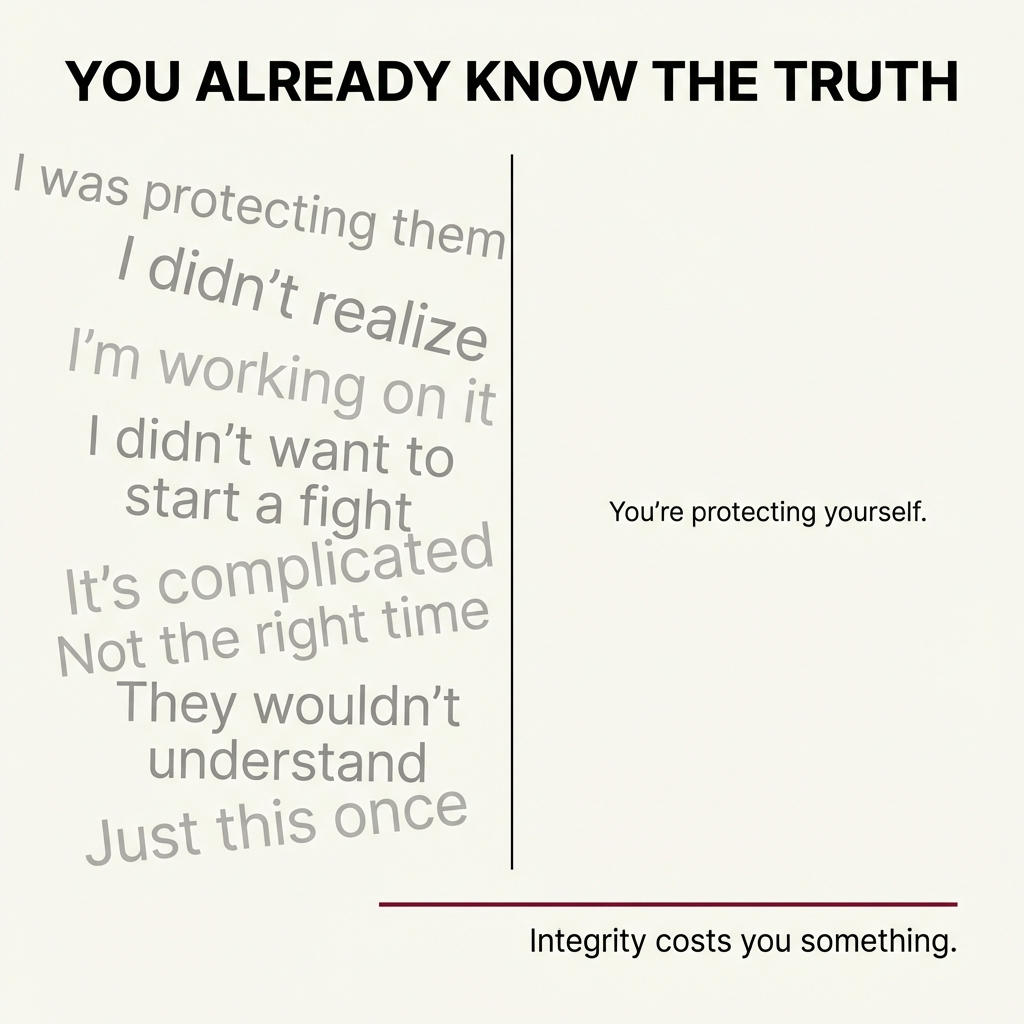
You’re just protecting yourself from what telling it would cost.
Most people get integrity wrong. They think of integrity as a personality trait you either have or don’t have. But integrity isn’t something you are. Integrity is something you do. Daily. Moment by moment.
Integrity is the alignment between what you know and what you do, even when the alignment threatens everything you’ve built to feel safe.
And most people fail at integrity constantly. Not because they’re bad people, but because telling the truth would dismantle the identity they’ve constructed to survive.
Why does this matter? What do you do about the gap between knowing and doing?
Integrity Is Expensive
Real integrity costs you something. Always.
It costs validation when you refuse to perform the version of yourself that keeps others comfortable.
It costs access when you stop accommodating dysfunction to maintain connection.
It costs control when you tell the truth before you’ve calculated how it will land.
Nobody wants to admit this next part.
Research on identity-protective cognition confirms what you’ve probably already experienced: people conform their understanding of reality to protect their group membership and self-concept. You selectively credit evidence that supports your existing beliefs and dismiss what threatens your sense of belonging.
You’re not confused. You’re strategic.
Your brain initiates self-deception before you’re even conscious of it. Studies using brain imaging show that self-deception is an adaptive defense response that happens spontaneously when you face emotional difficulty. You filter reality to reduce internal conflict and maintain self-esteem.
When you say “I didn’t realize,” what you often mean is “I couldn’t afford to realize.”
You weren’t confused. You were protecting yourself from knowing.
What Integrity Looks Like
Real integrity is alignment that persists even when the cost is high.
You’ll see this in four ways:
-
Owning the impact of your actions without justifying your intent. You don’t explain why you did something. You acknowledge what happened.
-
Telling the truth proactively, not reactively. You don’t wait until you’re caught or confronted. You speak before pressure builds.
-
Accepting consequences without demanding understanding. You don’t require others to validate your reasoning before you take responsibility.
-
Prioritizing clarity over being liked. You choose honesty even when it makes you the problem.
A 2025 study of over 200 couples found that expressed and perceived honesty predicted greater well-being and relationship satisfaction, even when the truth hurt. Being honest and being perceived as honest fostered closeness, regardless of whether partners perfectly understood each other.
Translation? The excuse “I was protecting them” doesn’t hold up.
You were protecting yourself from what their reaction would cost you.
The Shadow Side: How You Fake It
Most people are more strategic than honest.
You edit the truth based on your audience. You tell your therapist one version, your friend another, your partner a sanitized third. You’re not lying outright. You’re curating.
You confess just enough to relieve guilt without facing real consequences. You admit to a small infraction to avoid addressing the larger pattern. You perform accountability without changing behavior.
You use insight as insulation against correction. You say “I know I do this” as if awareness alone absolves you from responsibility. You’ve turned self-awareness into a shield.
You claim you’re working on it, repeatedly, without evidence of change. You announce your growth publicly while privately repeating the same patterns. You treat declarations of intention as substitutes for action.
This isn’t ignorance. This is self-protection. Strategic self-preservation.
And these strategies work. Until they don’t.
From Harm to Responsibility
Integrity isn’t about asking “Was I justified?”
The question is: “Was I clean in how I handled this?”
Clean means:
-
You acted without manipulation.
-
You didn’t omit critical information to control the outcome.
-
You didn’t use emotional leverage to avoid accountability.
-
You didn’t wait until anger forced the truth out.
Waiting until you’re furious to finally say what’s true isn’t integrity.
That’s pressure release.
Real integrity is telling the truth when you’re still calm enough to choose your words. Speak before resentment builds. Refuse to let silence become a weapon.
What This Looks Like in Real Relationships
The difference becomes clear when you’re in the middle of things:
Emotional withholding:
Lack of integrity: “I didn’t want to start a fight, so I stopped talking.”
Integrity: “I felt hurt by what you said, and instead of telling you, I shut down. That wasn’t fair to either of us.”
Staying while resentful:
Lack of integrity: “I stayed because I didn’t want to hurt them, but I stopped trying years ago.”
Integrity: “I’m here, but I’m not present. I need to either recommit fully or admit I’ve already left.”
Accountability theater:
Lack of integrity: “I know I have trust issues. I’m working on it.” (No visible change, repeated for months.)
Integrity: “I say I’m working on my trust issues, but I haven’t changed my behavior. I’m using awareness as an excuse to avoid real accountability.”
Research on behavioral integrity spanning 20 years confirms that alignment between words and deeds is the foundation of trust and commitment. When your behavior doesn’t match your stated values, people experience uncertainty about what’s actually true.
In other words: You create confusion when you perform integrity without practicing it.
The Questions You’re Avoiding
Where does your integrity break down? Ask yourself:
Where am I editing the truth to manage how I’m perceived?
What am I not saying because I’m afraid of the consequences?
Where am I using self-awareness as a substitute for behavior change?
What relationship am I staying in while withholding my real feelings?
Where am I waiting for anger to force me into honesty instead of choosing it proactively?
You already know the answers to at least one of these.
The real question is whether you’re willing to act on what you know.
Why You Keep Choosing the Lie
The truth is structurally threatening.
It threatens the version of yourself you’ve sold to others.
It threatens the relationships you’ve built on performance instead of presence.
It threatens the identity you’ve constructed to avoid facing what you actually want.
Classic studies on cognitive dissonance show that people change their beliefs to match their behavior rather than the reverse. When you act in ways contradicting your values, you don’t correct the behavior. You adjust what you claim to believe.
You tell yourself the lie was necessary. You reframe the omission as protection. You convince yourself that your silence was kindness.
Your brain helps you do this. The brain reduces the cognitive load of maintaining the deception by making you believe your own story.
Integrity doesn’t wait for comfort.
Integrity acts before the internal narrative has time to justify the avoidance.
What Happens When You Choose Truth
You lose some people.
Not everyone handles the version of you refusing to perform. Not everyone wants the relationship to be built on reality instead of carefully managed perception.
But you gain something more valuable:
You stop negotiating with your own clarity.
You stop wondering if you’re the problem.
You stop second-guessing what you know.
You stop waiting for permission to trust your own perception.
You build relationships where honesty is the baseline, not the exception. Where boundaries are architecture, not negotiation. Where your presence is enough because you’re not spending energy maintaining a performance.
Integrity doesn’t make life easier.
It makes it cleaner.
The Integration
Pick one area where you’ve been strategic instead of honest.
Not the biggest one. Not the most dramatic. One place where you know you’ve been editing reality to protect yourself.
Tell the truth there.
Not perfectly. Not with a full explanation. Cleanly.
Say what’s true without justifying why you waited. Own the impact without demanding understanding. Accept the consequence without requiring validation.
Then watch what happens when you stop performing integrity and start practicing it.
You don’t need more self-awareness.
You need to act on what you already know.
Discover more from Healing from Narcissistic Abuse, Toxic Relationships & Codependency | Christina Stuller
Subscribe to get the latest posts sent to your email.
