I need to tell you something that might make you uncomfortable.
The person who can’t leave their toxic relationship? They’re running the same neural pathways as someone shooting heroin in a back alley.
I’m not being dramatic. I’m being precise.
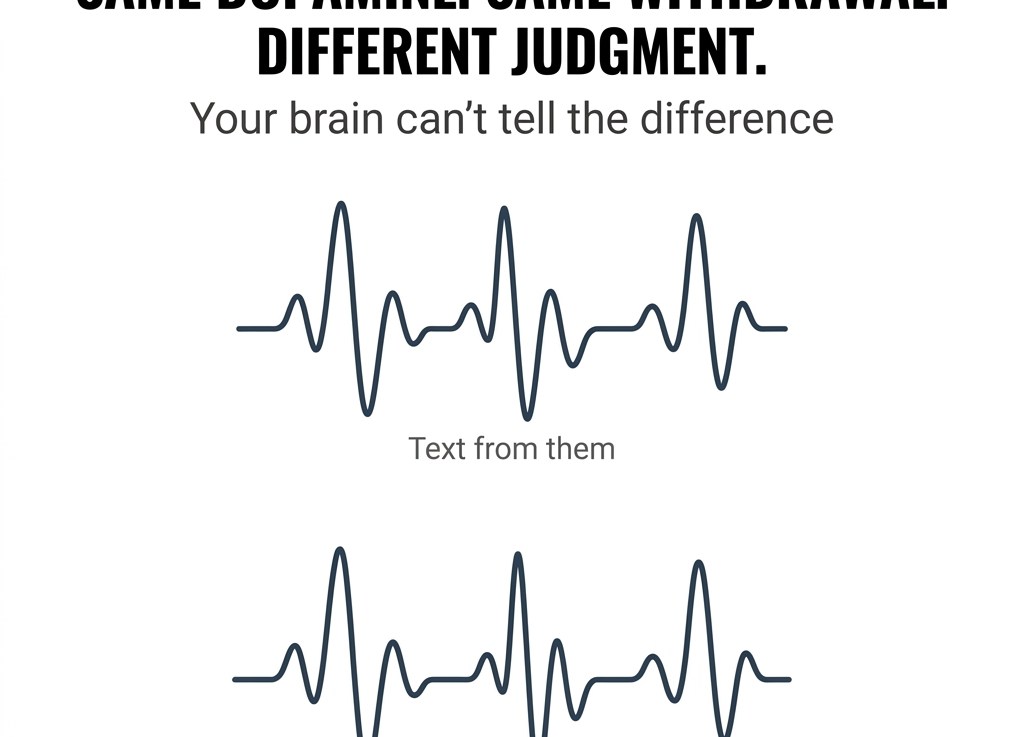
Your brain doesn’t distinguish between the high of a text message from someone who treats you like garbage and the high of a substance. The dopamine spike? Identical. The withdrawal? Identical. The relapse pattern? Identical.
But we treat these two addictions like they live in different universes.
One gets you a support group and sympathy. The other gets you judgment and the advice to “just leave.”
Both are survival responses to the same core wound: unbearable aloneness.
The Chemistry of Staying
You know what makes toxic relationships so chemically perfect for addiction? Intermittent reinforcement.
It’s the same mechanism that keeps people pulling slot machine levers for hours. Random rewards create stronger addiction than consistent ones.
When someone is cruel to you six days and kind on the seventh, your brain doesn’t average it out. It fixates on day seven. It waits for it. It craves it with an intensity that consistent kindness could never generate.
The narcissist who love-bombs you after a week of silent treatment isn’t just being unpredictable. They’re administering intermittent reinforcement. They’re the dealer and the drug.
And you’re not weak for staying. You’re chemically hooked on a pattern your nervous system learned to anticipate.
This is why “just leave” advice is about as useful as telling someone in opioid withdrawal to “just stop being sick.” The body doesn’t differentiate. The brain is in the same desperate place.
What Happens When You’re Alone
Here’s the part nobody wants to look at.
Addiction rises when isolation rises. Always.
We’re living through the most connected era in human history, and we’ve never been more alone. Social media promised community. It delivered performance anxiety and comparison loops.
You scroll through curated highlight reels and mistake visibility for intimacy. You rack up followers and feel emptier than before. The platforms aren’t designed to connect you. They’re designed to keep you scrolling.
And when you’re that alone, when the ache of disconnection becomes background noise you can’t turn off? You’ll reach for anything that makes it stop.
For some people, that’s substances. For others, it’s a person who makes them feel seen, even if that same person also makes them feel destroyed.
The toxicity becomes secondary to the relief. You’re not addicted to the abuse. You’re addicted to the moments when the pain pauses.
And when you try to leave? You’re not just walking away from a bad relationship. You’re walking into the void that relationship was covering up.
That’s the withdrawal. That’s why people go back. Not because they’re weak. Because the loneliness waiting on the other side feels worse than the chaos they know.
The Myth of Tough Love
We’ve been approaching addiction wrong for decades.
The tough love model operates on a simple belief: if you make the consequences painful enough, people will choose differently.
Kick them out. Cut them off. Let them hit rock bottom.
It sounds logical. It feels like accountability.
But Portugal proved it doesn’t work.
In 2001, Portugal decriminalized all drugs and redirected resources from punishment to connection. They didn’t just stop arresting people. They started reintegrating them. Job programs. Housing support. Therapy. Community.
The result? Drug-related deaths dropped by 80%. HIV infections among users fell dramatically. Addiction rates declined.
They didn’t shame people into sobriety. They built pathways out of isolation.
Because here’s what the data keeps showing us: addiction is not a moral failure. It’s an adaptation to disconnection.
When you treat someone like they’re broken, they stay broken. When you treat them like they’re isolated, and you address the isolation, they start to heal.
The same logic applies to codependency and toxic relationship patterns. You can’t shame someone into boundaries. You can’t isolate them into clarity.
Tough love just adds more pain to a system already drowning in it.
The Numbers Are Going to Get Worse
I’m not optimistic about where this is heading.
Loneliness is rising. Social media isn’t going anywhere. The platforms are getting better at hijacking your attention, not at fostering real connection.
We’re teaching an entire generation to interact through screens, to perform intimacy instead of practice it. Eye contact is becoming optional. Vulnerability is becoming content. Real connection? That’s becoming the rare thing.
And when your primary model for relationships is algorithmically curated and designed to maximize engagement (not depth), you’re going to see more addictive relationship patterns.
More people will stay in toxic dynamics because the alternative (being truly alone in a world that mistakes notifications for connection) is unbearable.
Addiction rates will climb. Codependency will become even more normalized. We’ll medicalize it, therapize it, and still miss the point.
The point is this: we’re not wired to be this disconnected.
Stop Judging. Start Changing.
You want to help someone stuck in a toxic relationship? Stop telling them to leave.
Start asking what they’re afraid will happen if they’re alone. Start being the kind of connection that doesn’t require performance or perfection.
You want to address addiction? Stop treating it like a character flaw.
Start treating it like what it is: a response to a system that isolates people and then punishes them for seeking relief.
The person texting their ex at 2am and the person using substances to numb out are doing the same thing. They’re trying to make the pain of disconnection stop.
And your judgment doesn’t help. Your tough love doesn’t help. Your advice to “just stop” doesn’t help.
What helps is connection. Real, consistent, non-performative connection.
What helps is addressing the isolation before it turns into dependency.
What helps is recognizing that the problem isn’t the person. It’s the environment that made addiction the most logical response to an illogical amount of pain.
Portugal figured it out. We’re still pretending punishment works.
The question isn’t why people get addicted. The question is why we’re so committed to keeping them that way.
The Real Controversy
Here’s what I actually believe, and it’s going to make some people angry:
If you’ve ever judged someone for staying in a toxic relationship, but you’ve never examined your own relationship with your phone, your work, your need for external validation? You’re not seeing clearly.
We’re all addicts. Some addictions just have better PR.
The person who can’t stop checking their ex’s Instagram? They’re no different than the person who can’t stop checking their work email at midnight. Both are running from the same thing.
The difference is one gets pathologized and the other gets called “dedication.”
We live in a culture that creates the conditions for addiction, then moralizes the people who fall into it.
And until we’re willing to look at the systemic isolation we’ve normalized, the judgment we’ve weaponized, and the disconnection we’ve monetized? The numbers will keep climbing.
You can’t fix an addiction epidemic by telling people to try harder.
You fix it by building a world where people don’t need to numb out just to get through the day.
Start there.
Discover more from Healing from Narcissistic Abuse, Toxic Relationships & Codependency | Christina Stuller
Subscribe to get the latest posts sent to your email.
