I need to tell you something that’s going to land hard. And I need you to sit with it instead of immediately deflecting.
That relationship destroying you? The one you keep defending at dinner parties while your friends exchange glances? Your brain is addicted to it the same way someone gets addicted to cocaine. Not metaphorically. Literally.
That lack of motivation you’re beating yourself up over? The reason you can’t seem to apply for new jobs, make therapy appointments, or even update your dating profile? It’s not a character flaw. It’s a survival mechanism your nervous system built to keep you safe in an environment that was never safe to begin with.
And that feeling of being stuck? Like you’re watching yourself make the same destructive choice over and over from behind glass? It’s not weakness. It’s what happens when your brain gets chemically rewired to seek relief from the very person causing your pain.
Let me show you what’s actually happening inside your head. And then I’ll show you why everything you’ve tried so far was never going to work.
Your Brain on Toxic Love: The Addiction Nobody Talks About
When researchers put people in fMRI machines and studied their brain activity, they found something most therapists won’t tell you outright. Probably because if they did, you’d realize just how hijacked you actually are.
The same reward centers that light up when someone uses drugs light up when a codependent person focuses on their partner. Your brain’s pleasure and reward center shows identical activation patterns whether you’re using cocaine or obsessing over someone who keeps hurting you.
This isn’t a metaphor. This is neuroscience. This is what’s happening in your skull right now while you’re reading this and simultaneously checking your phone to see if they texted back.
You’re not emotionally weak. You’re neurologically compromised.
The relationship didn’t just hurt your feelings. It changed your brain chemistry. And that’s why willpower alone won’t get you out. You’re trying to think your way out of a chemical dependency, which is like trying to reason with a craving while you’re in withdrawal.
The 64% Truth: Why Waiting for Change Is a Losing Strategy
Here’s the data point that should end every “but maybe they’ll change” conversation you’re having with yourself at 2 AM.
Narcissistic personality disorder has a 63-64% dropout rate from psychotherapy. That makes it one of the most treatment-resistant conditions in all of psychology.
Read that again. Let it settle. Let it ruin the fantasy you’ve been building where six more months of your patience finally breaks through.
Even when narcissists voluntarily enter therapy, nearly two-thirds quit. They don’t finish treatment. They don’t do the work. They don’t transform into the person you keep hoping they’ll become.
This statistic exists to tell you something critical: the person you’re trying to save through your love, your patience, or your perfect behavior isn’t going to change because you finally got it right.
You didn’t break them. You can’t fix them.
And every day you spend waiting is a day your brain stays wired to a system designed to keep you confused, depleted, and stuck.
Why Self-Sabotage Isn’t What You Think It Is
About 70% of adults engage in some form of self-sabotage. Procrastination alone affects roughly 20% of the population as a chronic pattern.
But here’s what most people miss: self-sabotaging behaviors aren’t character defects. They’re protective mechanisms.
Your brain learned that progress leads to punishment. That visibility invites criticism. That wanting something makes you vulnerable to having it used against you.
So it built a system to keep you small, quiet, and invisible.
The lack of motivation you’re experiencing isn’t laziness. It’s your nervous system prioritizing emotional safety over growth, even when that safety is a cage.
You’re not failing to move forward. You’re succeeding at staying safe in a framework that no longer serves you.
The question isn’t why you lack motivation. The question is: what did your brain learn to fear about progress? What happened the last time you wanted something out loud?
The Intermittent Reinforcement Trap
There’s a specific mechanism that keeps you hooked, and it’s the same one casinos use to keep gamblers at the slot machines. Except the slot machine is a person, and the jackpot is basic human decency.
Intermittent reinforcement.
When positive actions are unpredictable, your brain doesn’t just respond to the reward. It gets addicted to the possibility of a reward. Researchers call this a “reward prediction error,” and it’s a core component of addiction.
In a toxic relationship, this looks like:
Three days of coldness, then one night of intimacy.
Two weeks of criticism, then one compliment that you’ll replay for a month.
A month of distance, then sudden affection that feels like coming home.
Your brain doesn’t interpret this as abuse. It interprets it as a puzzle to solve.
And every time you get a hit of warmth after a stretch of coldness, your brain floods with dopamine and tells you: “See? You just needed to try harder. You’re finally getting it right.”
This is why you don’t walk away. Your brain is chemically rewarding you for staying.
The chaos isn’t a bug in the relationship. It’s the feature that keeps you addicted. It’s working exactly as designed.
Gaslighting Rewires Your Reality
New research from 2024 confirms what survivors already know: gaslighting alone, separate from other forms of abuse, independently predicts depression.
A 2025 study went further. It showed that psychological cruelty combined with isolation predicts depression more strongly than physical or sexual abuse.
Let that sink in.
The devaluation phase produces predictable injuries: hypervigilance, sleep disruption, intrusive thoughts, and a profound loss of access to your own perceptions, preferences, and values. You stop knowing what you like. What you think. What happened five minutes ago.
You didn’t lose your sense of self because you’re weak. You lost it because having your reality denied, dismissed, or punished is a direct assault on your cognitive architecture.
Gaslighting doesn’t just make you doubt yourself. It dismantles the infrastructure you use to know what’s true.
And when you can’t trust your own perception, you can’t make decisions. You can’t set boundaries. You can’t leave. You stand in the parking lot of your own life, keys in hand, unable to remember where you parked.
You’re stuck because the mechanism you’d use to get unstuck has been systematically disabled. It’s like trying to use a compass that’s been demagnetized. Nobody told you it’s broken, so you keep spinning in circles wondering why you can’t find north.
Maybe you’ve caught yourself saying things like: “Did I imagine that?” “Am I being too sensitive?” “Maybe I’m the problem.”
That’s not self-awareness. That’s the injury talking.
You’re not crazy. You’re responding exactly the way any human responds when the person they trust most tells them their reality isn’t real. You adapt. You doubt. You shrink your truth down until it fits inside the space they’ve decided to allow you.
Trauma Bonding: When Pain and Love Fuse
Here’s the part that feels impossible to explain to people who haven’t lived it. The part that makes you sound insane when you try to describe why you can’t just leave.
When abuse is followed by kindness, your brain experiences relief. That relief comes with surges of dopamine and oxytocin, the same chemicals associated with love and connection.
Over time, your brain learns to associate the person causing your pain with the relief from that pain.
Pain and love become fused.
This isn’t emotional confusion. This is your brain rewiring itself under chronic stress, creating a physiological dependency that logic can’t override.
The emotional highs and lows create a neurochemical loop. Your brain becomes conditioned to seek relief from distress through the very person causing it.
This is why you can know someone is bad for you and still feel pulled back. This is why you can write out all the reasons to leave and then delete the draft. Your nervous system is running a program that treats their presence as survival.
You’re not choosing poorly. You’re operating from a hijacked reward system.
Think about it. You’ve probably spent hours trying to figure out what you did wrong. You’ve replayed conversations word by word. You’ve changed your tone, your timing, your approach. You’ve made yourself smaller, quieter, more accommodating. And occasionally, just often enough to keep you hooked, it worked. They softened. They smiled. They touched your face the way they used to.
And your brain logged that as: Success. Do more of that.
Except “that” is erasing yourself. And the reward isn’t love. It’s relief from the pain of their withdrawal.
This is why you can’t logic your way out. Your brain isn’t tracking truth. It’s tracking survival.
The Way Out Isn’t What You’ve Been Told
Most recovery advice treats this like an emotional problem that needs processing.
I’m telling you it’s a structural problem that needs dismantling.
You don’t need more insight into why they hurt you. You need to interrupt the neurological loop that keeps you seeking relief from the source of your pain.
Here’s what actually works:
Stop waiting for clarity to feel motivated. Motivation follows action, not the other way around. Your brain is wired to seek the familiar. You have to move before you feel ready.
Treat it like addiction recovery, not relationship advice. You need the same level of intervention someone needs to quit a substance. No contact isn’t cruelty. It’s detox.
Build boundaries as infrastructure, not negotiation. You don’t argue for space. You create it and enforce the walls. Boundaries aren’t conversations. They’re decisions you make and systems you install.
Recognize that your lack of motivation is information. Your nervous system is telling you it doesn’t feel safe to want things. That’s the injury. Address the safety, not the motivation.
Stop trying to understand them. The 64% treatment resistance rate exists to tell you: this isn’t a puzzle you can solve by finally understanding the right thing. They’re not confused. They’re committed to a pattern that works for them.
Find meaning in the wreckage. Research shows that women who found purpose after narcissistic abuse experienced better mental health and greater willingness to stand up for themselves. Healing isn’t about processing forever. It’s about building functional autonomy.
What Happens When You Stop Negotiating With Your Own Clarity
You already know what’s true. You’ve known for months. Maybe years.
You know the relationship is destroying you. You know the pattern won’t change. You know staying means choosing their dysfunction over your own architecture. You know it the same way you know when you’re about to get sick. Not because anyone told you, but because your body is sending signals you’ve learned to ignore.
The problem isn’t knowledge. The problem is that your nervous system is running a program that treats leaving as more dangerous than staying.
So here’s the reset:
Your brain will not give you permission to leave. It’s chemically invested in the bond.
Your emotions will not provide clarity. They’re responding to a hijacked reward system.
Your motivation will not arrive before you move. It shows up after you’ve already started building the exit.
The way out isn’t through more understanding, more patience, or more hope that things will shift.
The way out is through structural disruption.
You stop feeding the system. You stop seeking relief from the source of pain. You start treating your nervous system like it’s in active addiction, because it is.
And you build the boundaries, the distance, and the new patterns before your brain agrees it’s safe.
You don’t wait for readiness. You move while still afraid. You pack the bag before you know where you’re going. You block the number while your hand is shaking.
That’s not weakness. That’s the only way the neurology resets.
The Truth About Being Stuck
Being stuck isn’t a character flaw.
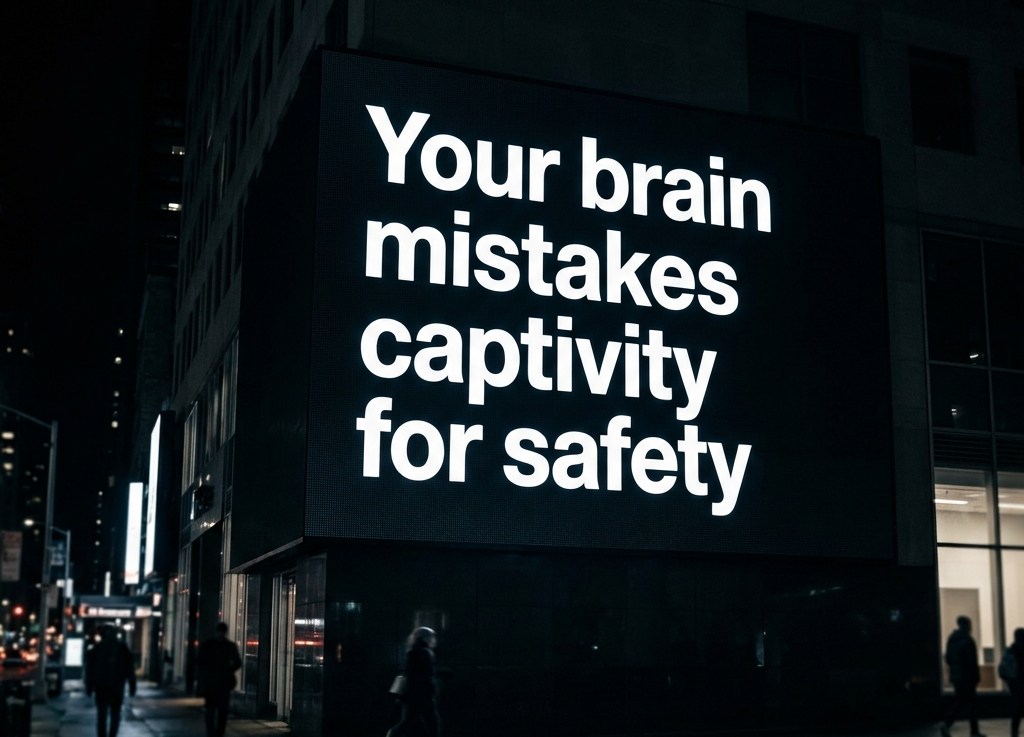
It’s what happens when your survival system mistakes captivity for safety.
You’re not too weak to leave. You’re too wired to the bond. And the bond isn’t love. It’s a neurological trap that treats chaos as home.
The power in being stuck is this: once you see the mechanism, you stop blaming yourself for the cage.
You start dismantling it instead.
No sugar coating. No waiting for the right feeling. No hoping they’ll change so you don’t have to.
You take the data, you recognize the pattern, and you build the exit while your nervous system is still screaming at you to stay.
That’s not cruelty. That’s structural transformation.
And it’s the only way out.
The Question That Will Follow You Home
So here’s what I want you to sit with today, tonight, and tomorrow morning when you wake up and check your phone before you’ve even opened your eyes:
How much of your life are you willing to spend as evidence that someone else should have been different?
Not how much have you already spent. How much more are you willing to invest in a person who has shown you, not through their words but through the pattern, who they are?
Because here’s the thing about waiting for them to change: every day you wait is a day you’re not building the life that’s waiting on the other side of this. Every day you spend trying to decode their behavior is a day you’re not learning to trust your own perception again. Every day you stay is a day your brain stays wired to chaos.
You think you’re waiting for them to become someone worthy of your love.
But what you’re actually doing is training yourself to tolerate less and less until there’s nothing left of you that remembers what safety feels like.
That’s not patience. That’s not loyalty. That’s not love working through hard times.
That’s negotiating with your own extinction.
You Don’t Need Another Article. You Need a System.
If you’ve read this far, you already know everything I’ve said is true. You’ve probably known for longer than you’ve been willing to admit.
The problem was never information. The problem is that your nervous system is running a program designed to keep you exactly where you are. And reading articles, listening to podcasts, talking to friends who tell you what you already know? None of that interrupts the wiring.
What interrupts the wiring is a structured approach that treats this like the neurological hijacking it actually is.
That’s why I built Healing but Dealing. Not as another place to process your feelings, but as a system for dismantling the mechanisms keeping you stuck. This isn’t therapy talk. This is pattern recognition, boundary architecture, and the kind of radical clarity that makes staying more uncomfortable than leaving.
If you’re done waiting for your brain to give you permission, if you’re done hoping six more months of perfect behavior will finally break through, if you’re ready to treat this like the addiction it actually is, start here.
No sugar coating. No waiting for readiness. No pretending this gets easier if you just understand it better.
Just the tools to build the exit while your nervous system is still screaming at you to stay.
Because the version of you that’s waiting on the other side? She’s not interested in understanding why it happened.
She’s interested in making sure it never happens again.
Discover more from Healing from Narcissistic Abuse, Toxic Relationships & Codependency | Christina Stuller
Subscribe to get the latest posts sent to your email.
